For decades, wheat has been the undisputed king of Indian kitchens. Rotis made of atta, biscuits baked in maida, bread for breakfast — wheat is everywhere. Meanwhile, traditional grains like jowar, bajra, and ragi quietly faded from daily meals, tagged as "poor man's food" or simply forgotten in favour of convenience.
But here's the question more and more health-conscious Indians are now asking: Was that trade-off worth it?
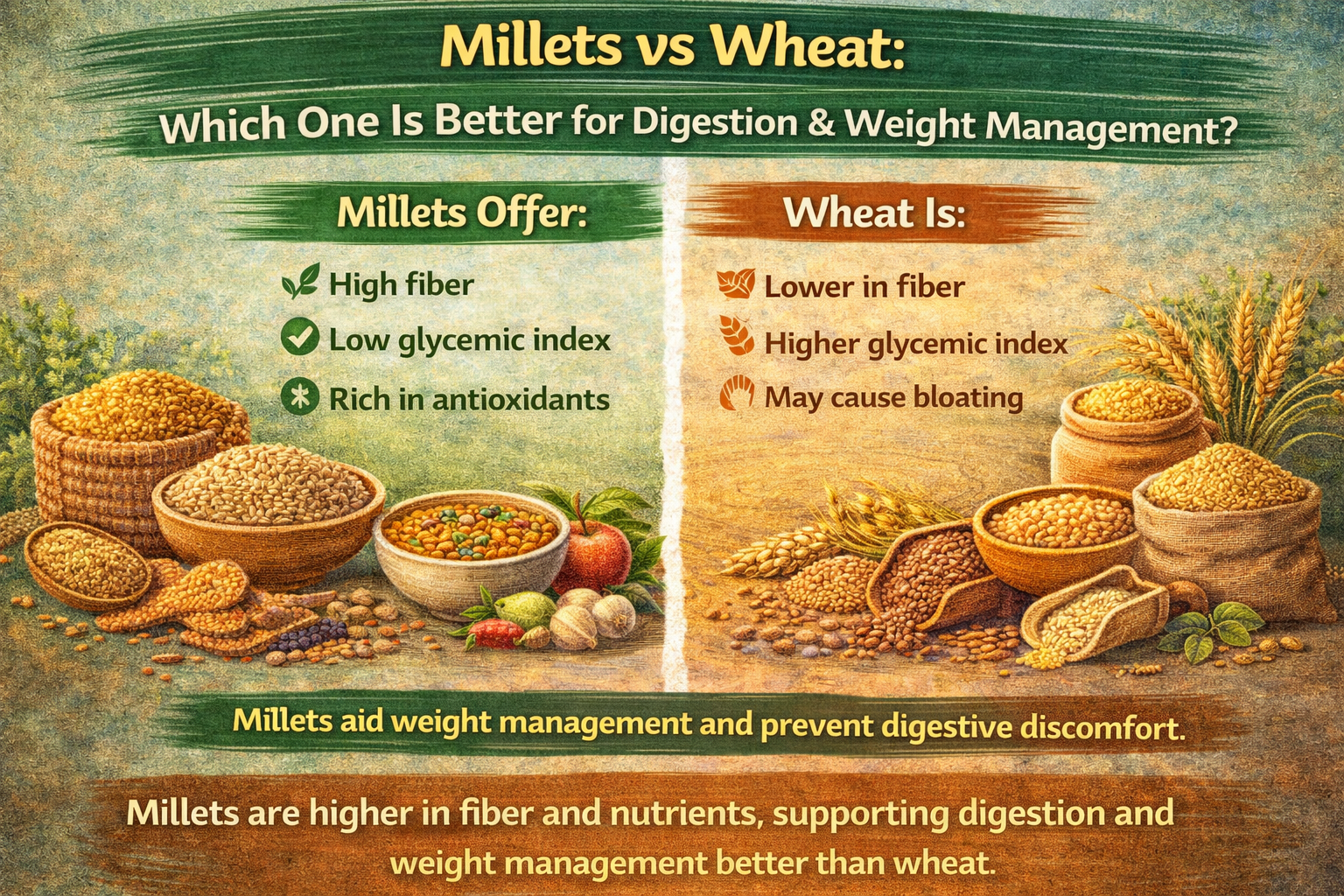
When you place millets and wheat side by side and look at how they behave inside your body — in your gut, in your blood sugar response, in your metabolism — the answer becomes quite clear.
Let's break it down properly.
What Exactly Are Millets?
Millets are a group of small-seeded cereal grains that have been cultivated in India for over 5,000 years. The most common ones are:
- Jowar (sorghum)
- Bajra (pearl millet)
- Ragi (finger millet)
- Foxtail millet
- Kutki (little millet)
Unlike refined wheat flour (maida), millets are consumed closer to their whole grain form — meaning they retain their outer bran layer, germ, and all the nutrition packed within.
Refined wheat, on the other hand, has had its bran and germ stripped away during processing. What remains is mostly starch — fast-digesting, nutrient-poor, and hard on your metabolism.
Millets vs Wheat: The Digestion Comparison
How wheat affects digestion
Refined wheat flour (maida) is one of the most digestive-system-disrupting foods in the modern Indian diet. Here's why:
It is low in dietary fiber, which means food moves through the gut slowly, causing bloating, constipation, and sluggish bowel movements. Wheat also contains gluten — a protein that, in sensitive individuals, causes inflammation in the gut lining. Even people without diagnosed celiac disease often experience bloating, gas, and discomfort from regular gluten consumption.
Maida-based foods like bread, biscuits, namkeen, and white pasta also feed harmful gut bacteria rather than beneficial ones, slowly degrading the gut microbiome over time.
How millets support digestion
Millets are naturally gluten-free and high in soluble and insoluble fiber. This fiber does several important things:
It slows the movement of food through the digestive tract (but in the right way — not causing constipation), allowing better nutrient absorption. It feeds beneficial gut bacteria (acting as a prebiotic), strengthening the gut lining. It bulks up stool and supports regular, effortless bowel movements. It reduces gut inflammation — something particularly helpful for those with IBS, acidity, or chronic bloating.
Jowar, in particular, contains resistant starch — a type of fiber that bypasses the small intestine and feeds beneficial bacteria in the colon. Ragi is rich in polyphenols that actively reduce gut inflammation.
Bottom line on digestion: Millets win, clearly.
If you want to experience the difference, try swapping your evening biscuits to Nutramore's Jowar Coconut Cookies or Jowar Chocolate Cookies — baked with whole jowar, jaggery, and zero refined flour. Many customers notice a visible improvement in digestion within the first week.
Millets vs Wheat: The Weight Management Comparison
Why wheat contributes to weight gain
The problem isn't wheat in its whole grain form — the problem is how we consume it. In India, most wheat consumption happens as maida (refined flour) — in biscuits, bread, naan, namkeen, and packaged snacks.
Maida has a high glycemic index (GI of 71–85). This means it gets converted to blood sugar very rapidly after eating. A spike in blood sugar triggers a spike in insulin. Insulin promotes fat storage — particularly around the abdomen. Shortly after, blood sugar crashes, making you hungry again. This cycle of spike → crash → craving → overeat is the exact metabolic pattern that drives weight gain over time.
Additionally, refined wheat products are rarely filling. You can eat a full packet of maida biscuits and feel hungry within an hour.
Why millets support weight management
Millets digest slowly. Their low glycemic index (54–68) means glucose is released gradually into the bloodstream — no spike, no crash, no sudden hunger. This keeps you feeling full for longer after every meal or snack.
The high fiber content of millets adds to satiety — physically taking up space in the stomach and slowing digestion. Studies show that people who include millets in their diet tend to consume fewer total calories throughout the day simply because they stay fuller longer.
Millets also support better insulin sensitivity over time. In people managing pre-diabetes, PCOD, or obesity, replacing refined grains with millets has shown measurable reductions in fasting blood sugar and waist circumference.
For a practical and delicious way to include millets in your snacking routine, Nutramore's Bajra Cookies are made from pearl millet, sweetened only with jaggery, and contain no refined sugar or flour — making them a genuinely weight-friendly snack option.
The Gluten Question: Who Should Be Especially Careful?
Gluten is a protein found in wheat, barley, and rye. For those with celiac disease, gluten consumption directly damages the small intestine. But even outside celiac, non-celiac gluten sensitivity affects a surprisingly large number of people — causing symptoms like bloating after meals, fatigue, brain fog, skin issues, and joint pain.
Because millets are entirely gluten-free, they are safe for everyone — including those with celiac disease, gluten intolerance, or anyone looking to reduce gut inflammation.
If you've been looking to go gluten-free without giving up satisfying snacks, Nutramore's Gluten-Free Cookies Combo — featuring Multigrain Coffee Cookies, Bajra-Moong Chocolate Cookies, and Rice-Ragi Cookies — is a great starting point.
Nutrient Density: Where Millets Simply Have No Competition
Let's look at what you get from millets that refined wheat simply cannot offer:
Calcium — Ragi has ~344mg of calcium per 100g. Milk, by comparison, has ~120mg per 100ml. This makes ragi one of the richest plant-based calcium sources available — crucial for bone health, especially in children, women, and seniors. Nutramore's Ragi Chocolate Cookies and Rice Ragi Cookies make getting this calcium remarkably easy and tasty.
Iron — Bajra is an excellent source of iron. Refined wheat contains minimal iron, and whatever iron is in fortified flour is often in a form the body absorbs poorly. For those dealing with anaemia or low energy, Bajra Moong Chocolate Cookies offer a genuinely iron-rich snacking option.
Protein quality — Millets (especially when combined with pulses like moong or green gram) form a complete protein profile — meaning they provide all essential amino acids. Refined wheat is an incomplete protein, low in the essential amino acid lysine.
Magnesium and phosphorus — Both support muscle function, energy metabolism, and bone health. Millets contain significantly higher levels of both compared to refined wheat.
What About Whole Wheat? Isn't That Also Healthy?
This is a fair question. Whole wheat atta is certainly better than refined maida — it retains more fiber and nutrients. If you are choosing between whole wheat roti and a maida biscuit, the roti wins.
However, even whole wheat has a higher glycemic index than most millets. Whole wheat also contains gluten. And its nutrient density — especially for calcium, iron, and magnesium — is still considerably lower than that of millets.
The comparison becomes clearest when you look at packaged food. Most wheat-based snacks marketed as "healthy" are made with refined flour, artificial flavours, and refined sugar. Genuine whole wheat snacks are rare in the market.
Millets, by their nature, are harder to over-process — they retain nutrition even in baked formats, which is why Nutramore chose them as the foundation for every product.
Easy Ways to Make the Shift
You don't need to overhaul your entire diet overnight. Small, consistent swaps make the biggest difference:
Replace your tea-time biscuits with millet-based cookies — try Nutramore's Trial Pack with 9 flavours to find what you love most.
Replace your morning upma made from semolina (which is wheat) with Jowar Upma Premix or Green-Gram Upma Premix — both ready in minutes and far superior nutritionally.
Replace your wheat flour chilla with Jowar Chilla Mix — high in complete protein and omega-3, and genuinely diabetic-friendly.
Replace your afternoon fried snack with Millet Methi Crispies or Baked Protein Sticks — baked, not fried, and rich in protein.
Who Benefits the Most from Switching to Millets?
The answer is: almost everyone. But these groups benefit especially:
People with diabetes or pre-diabetes — the low GI and high fiber of millets help regulate blood sugar naturally. Jowar Upma and Jowar Chilla Mix are particularly well-suited.
People trying to lose weight — the satiety and metabolic benefits of millets make them a practical tool for calorie management without starvation.
Children and toddlers — ragi's calcium content supports growing bones. Nutramore's Sugar-Free Toddler Combo (Ragi + Moong + Rice cookies) is a parent-favourite for this exact reason.
Pregnant and breastfeeding women — the iron in bajra, the calcium in ragi, and the protein in moong are exactly what expecting and new mothers need. The Multigrain Cookies Combo for Moms is specifically curated for this life stage.
Seniors — calcium, magnesium, and easily digestible proteins from millets support bone density, muscle health, and gut function as the body ages.
Final Thoughts
The comparison between millets and refined wheat isn't really close. Millets offer superior fiber, better glycemic response, richer micronutrients, complete protein, and no gluten — all while being rooted in Indian culinary tradition.
The challenge has never been whether millets are good for you. The challenge has always been making them convenient, tasty, and accessible in daily life.
That's the gap Nutramore was built to fill.
Whether it's a quick breakfast premix on a busy morning or a satisfying evening snack with tea, the goal is the same: bring the nutritional intelligence of traditional Indian grains back to modern tables — without compromise on taste or convenience.
Explore all Nutramore products at nutramore.in/our-products
millets, wheat, digestion, weight management, gluten-free, jowar, bajra, ragi, healthy snacks, Indian nutrition, blood sugar, high fiber