From Toddlers to Teens: How Snack Needs Change with Age
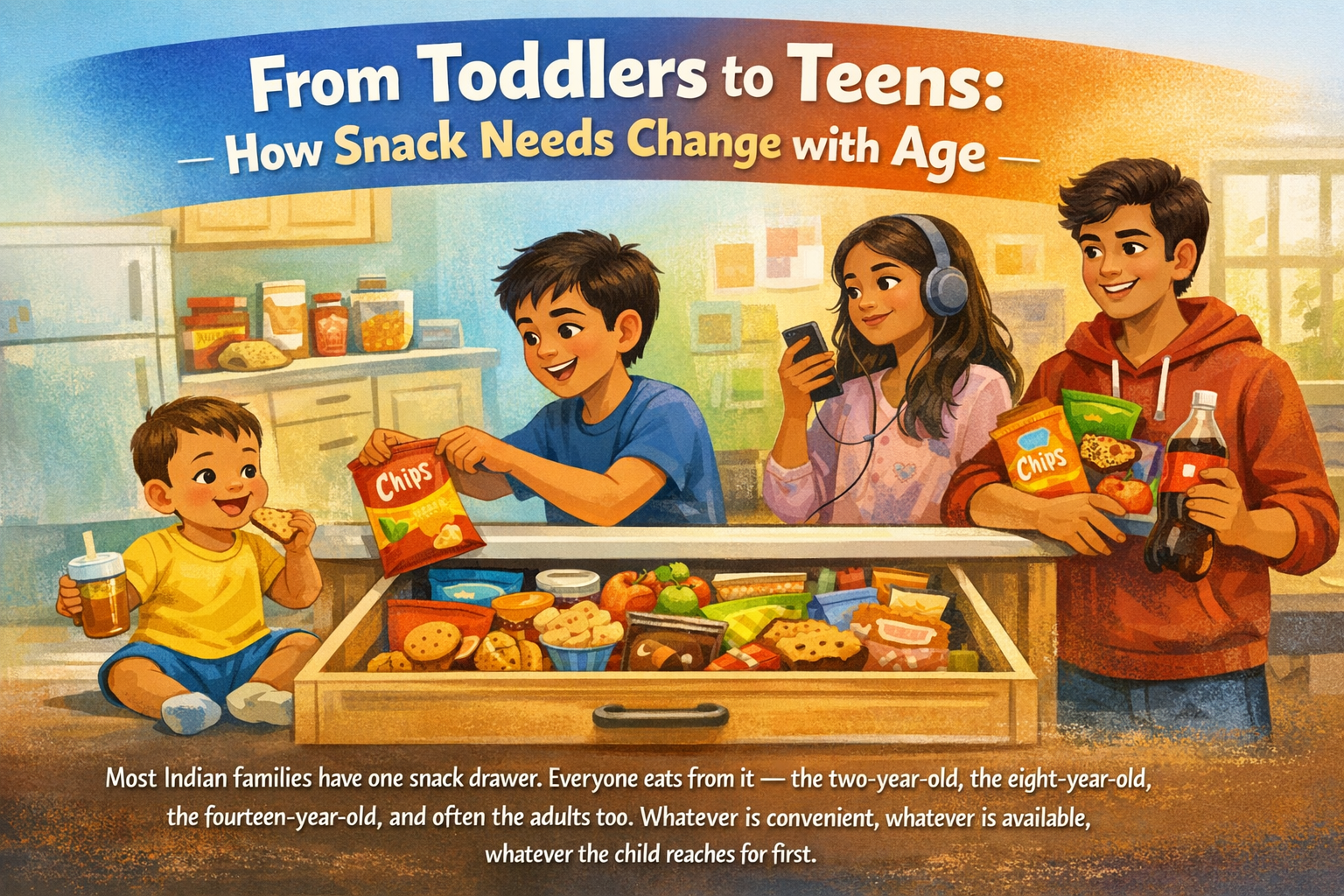
Most Indian families have one snack drawer. Everyone eats from it — the two-year-old, the eight-year-old, the fourteen-year-old, and often the adults too. Whatever is convenient, whatever is available, whatever the child reaches for first.
The problem with this approach is that a two-year-old and a fourteen-year-old are not nutritionally the same creature. They are in fundamentally different biological phases — different rates of growth, different organ systems under active development, different hormonal environments, different cognitive demands, and dramatically different daily energy expenditures. The snack that is ideal for one stage of childhood can be inadequate, poorly matched, or actively counterproductive at another.
Understanding how a child's nutritional needs evolve from toddlerhood through adolescence — and what that means for snacking specifically — is one of the most practically useful things a parent can know. It transforms snack choices from a daily guess into a targeted decision rooted in what the child's body is actually doing right now.
This blog takes you through each major stage of childhood — toddlers (1–3), early childhood (4–6), school age (7–10), pre-adolescence (11–13), and adolescence (14–18) — explaining what is happening physiologically at each stage, what nutritional priorities follow from that, and what kinds of snacks genuinely serve those needs.
Why Age-Appropriate Snacking Matters More Than Parents Realise
Before going stage by stage, it helps to understand why this matters beyond the obvious "different ages, different portions" intuition.
Children are not simply growing bigger across childhood — they are moving through distinct developmental phases, each characterised by specific biological demands. The toddler years are a period of explosive brain development, requiring specific fats and micronutrients for neural architecture. The early school years are a period of bone mineralisation and gut microbiome consolidation, demanding calcium, magnesium, and fiber. Pre-adolescence is when the hypothalamic-pituitary axis begins activating, placing new demands on iron, zinc, and B vitamins. Adolescence — particularly for girls — brings the highest iron, calcium, and protein requirements of any life stage outside pregnancy.
Each of these phases has a nutritional sweet spot. Hitting that sweet spot consistently — not just at main meals, but across the two or three daily snack occasions that bookend and bridge those meals — produces measurably better outcomes in growth, cognitive development, immune function, and long-term metabolic health.
Missing it — through age-inappropriate snacks that are too low in the nutrients a specific phase demands — doesn't produce obvious immediate harm. The harm is cumulative and quiet: slower brain development, less robust bone mineralisation, weaker immune responses, more fatigue, more difficulty concentrating, and nutritional deficits that, once established across a phase, can take months or years to fully correct.
Snacks matter at every age because they represent two or three additional nutritional opportunities every single day. Whether those opportunities are used well or wasted is largely a function of whether the parent knows what the child's body is actually asking for.
Stage 1: Toddlers (Ages 1–3)
What Is Happening Biologically
The toddler years are one of the most nutritionally demanding phases of human development — matched in intensity only by the first year of life and adolescence. Between ages one and three, the brain is growing at a rate it will never match again: neural connections are being formed at extraordinary speed, myelin sheaths are being laid down around nerve fibres to enable fast, efficient transmission, and the foundations of language, memory, and emotional regulation are being built.
The gut microbiome, which was relatively simple at birth, is diversifying rapidly during this period — establishing the microbial community that will influence immune function, metabolic health, and even cognitive development for decades. What a toddler eats now directly shapes that microbiome.
Bone density is accumulating. Motor skills are developing. The immune system is encountering new antigens constantly as the toddler engages with the world — and building its library of memory responses for the first time.
All of this happening simultaneously creates extraordinary nutritional demand in a body that is still very small, still developing the mechanical capacity to chew a wide range of textures, and with a stomach capacity that limits how much can be eaten at any single sitting.
What Toddlers Need from Snacks
Easily digestible formats. A toddler's digestive system is not yet fully mature. Snacks must be soft, easily broken down, and free from anything that poses a choking risk. Hard, dry, coarse textures need to be absent or minimal.
High calcium for bone and neural development. The first three years see rapid bone mineralisation. Calcium, along with vitamin D, is the critical mineral for this process. Ragi — with its extraordinary calcium density — is one of the most valuable foods available for toddlers, making ragi-based snacks genuinely therapeutic for this age group.
Iron for brain development and immune function. Iron deficiency in the toddler years is particularly consequential because iron is essential for the myelination process — the laying down of myelin sheaths that allow the brain's neural circuits to transmit signals efficiently. Iron deficiency during this window has been linked to measurable cognitive deficits that can persist even after the deficiency is corrected. Bajra's iron richness makes it a priority ingredient for toddler snacks.
No refined sugar. The toddler's gut microbiome is still being established. Repeated exposure to refined sugar during this formative period disrupts the microbial balance in ways that have long-term consequences for immunity, metabolism, and appetite regulation. Jaggery-sweetened foods are meaningfully safer — providing a gentle sweetness with iron and mineral content rather than pure glycemic disruption.
Moderate protein, easily digestible. Rice-based proteins are among the most easily digestible for toddlers — rice protein has the lowest allergenic potential and the gentlest digestive demand. As the toddler's digestive system matures, moong protein can be introduced — moong dal is one of the most digestible legumes available.
Best Snack Choices for Toddlers
Nutramore's Sugar-Free Cookies Combo for Toddlers — combining Ragi, Moong, and Rice cookies — is specifically formulated for this stage. The combination covers the three most critical toddler nutritional priorities: ragi delivers calcium, moong introduces easily digestible pulse protein, and rice provides gentle, easily digestible complex carbohydrate. All three are jaggery-sweetened, eggless, and made without refined sugar or maida.
The Rice cookies in particular deserve attention for toddlers — rice protein has the highest digestibility rating of any common grain protein, making it an ideal introduction to solid snack foods for children transitioning from purees. The Rice Cookies are light, easily held by small hands, and flavourful enough to be genuinely enjoyed without being so intensely sweet that they establish an unhealthy sugar preference.
As the toddler approaches age two and three and digestive capacity increases, the Ragi Chocolate Cookies become a particularly valuable addition — delivering exceptional calcium in a chocolate-flavoured format that toddlers find consistently appealing.
Stage 2: Early Childhood (Ages 4–6)
What Is Happening Biologically
Between four and six, the explosive neurological growth of the toddler years begins to consolidate. Brain volume approaches adult size, though significant internal organisation — myelination, synaptic pruning, and prefrontal cortex development — continues. Children at this stage are developing the cognitive foundations of learning: attention, working memory, language complexity, and early numeracy.
The gut microbiome reaches a more stable composition during this period, though it remains responsive to dietary inputs. Bone mineralisation continues at a steady pace. Physical growth rates, while no longer as explosive as in infancy and toddlerhood, are consistent — requiring sustained protein, calcium, and energy supply.
Children at this stage also become increasingly social around food — eating at kindergarten or preschool, sharing snacks with friends, developing strong and often rigid food preferences. What children eat at this stage begins to shape their long-term relationship with food as much as it shapes their biology.
What Early Childhood Needs from Snacks
Sustained energy for cognitive development. Learning requires glucose — specifically the steady, slow-release glucose that complex carbohydrates from whole grains provide. The difference between a child who arrives at their morning lesson alert and focused versus fidgety and distracted is often the glycemic profile of their mid-morning snack.
Protein for attention and neurotransmitter support. Amino acids from protein are the precursors to dopamine and serotonin — the neurotransmitters most directly involved in attention, mood regulation, and motivation. Children eating adequate protein throughout the day consistently show better attention spans and more stable emotional regulation than protein-deficient peers.
Calcium and magnesium for bone and nervous system. This is a critical window for bone density accumulation. The calcium deposited in bones between ages four and twelve is significantly more important to lifetime bone density than calcium consumed in adulthood. Magnesium, which works alongside calcium, supports both bone mineralisation and the nervous system function that underlies learning.
Texture and independence. Children at this stage are developing autonomy and strong preferences. Snacks that can be held, eaten independently, and feel like "theirs" are important for this developmental phase. Cookie formats work particularly well — they are age-appropriate, manageable, and feel like a treat without being one nutritionally.
Best Snack Choices for Ages 4–6
The Jowar Coconut Cookies and Rice Ragi Cookies work very well at this stage — the coconut flavour appeals to young children who are transitioning away from purely sweet preferences, while the jowar provides the slow-release complex carbohydrate that supports sustained classroom attention. The rice-ragi combination delivers calcium from ragi in a gentle, easy-to-digest matrix.
After school, the Jowar Upma Premix — prepared warm in under ten minutes — provides the protein and complex carbohydrate combination that prevents the late-afternoon blood sugar dip and supports the energy needed for play and early evening activity.
For lunch boxes, the Millet Methi Crispies introduce a savoury flavour dimension that broadens palate development at this formative stage — children who encounter a wider range of flavours between four and six develop more varied food preferences that persist into later childhood and adolescence.
Stage 3: School Age (Ages 7–10)
What Is Happening Biologically
The school-age years are often underestimated nutritionally because they fall between the dramatic growth of early childhood and the visible changes of adolescence. In reality, this is a period of important consolidation — cognitive architecture is being reinforced, social-emotional development is accelerating, physical coordination and strength are developing, and the body is quietly accumulating the nutritional reserves — particularly bone density and iron stores — that will be drawn upon heavily during the adolescent growth spurt that follows.
The prefrontal cortex is undergoing significant development during this period — the brain region responsible for planning, impulse control, problem-solving, and emotional regulation. This development is nutritionally dependent: omega-3 fatty acids, iron, zinc, and B vitamins are all required for prefrontal maturation.
Children at this age are spending more time at school, more time doing homework, and more time in organised activities — all of which place sustained demands on attention, working memory, and emotional regulation. The nutritional support for all of these functions comes from the cumulative quality of everything the child eats across the day.
What School-Age Children Need from Snacks
Brain-supporting nutrients. Iron for attention and processing speed. Zinc for memory consolidation. B vitamins for neurotransmitter synthesis. These nutrients are the nutritional foundation of academic performance — not in a marketing-claim sense, but in a mechanistic, documented sense. Children with adequate iron status score measurably higher on attention and cognitive tests than iron-deficient peers matched for socioeconomic status and school quality.
Adequate protein for body composition. This age range sees the beginning of meaningful muscle development — children become stronger and more physically capable between seven and ten. Adequate protein supports this development without the hormonal complexity of adolescence.
Fiber for gut health and mood. The gut-brain axis — the communication pathway between gut microbiome and brain — influences mood, anxiety, and cognitive function in ways that are increasingly well-documented. Children with diverse, fiber-fed gut microbiomes consistently show better emotional regulation and lower rates of anxiety than children eating low-fiber diets.
Enough energy for sustained activity. School-age children are physically active in ways that toddlers and adolescents are not — they run, play, climb, and sport. Their energy demands are high relative to body size and must be met with complex carbohydrates that deliver sustained fuel rather than the spike-and-crash of refined snacks.
Best Snack Choices for Ages 7–10
This is the age range for which the broadest range of Nutramore snacks is appropriate and genuinely useful. The All-Time Favourite Cookies Combo — rotating through Jowar, Rice-Ragi, and Bajra cookies — covers iron (bajra), calcium (ragi), and sustained energy (jowar) in a format that fits easily into a lunchbox and provides genuine variety across the week without requiring daily decision-making.
The Baked Protein Sticks become particularly valuable at this stage — 18g of protein per pack is a meaningful contribution to the protein needs of a growing, physically active child, and the savoury dal flavour provides a satisfying, complete sensory experience that reduces the craving for salty fried snacks.
After school, the Green-Gram Upma Premix or Jowar Chilla Mix — both delivering 30–32g of protein — provide the post-activity protein that supports muscle repair and the sustained energy needed for homework focus in the early evening.
Stage 4: Pre-Adolescence (Ages 11–13)
What Is Happening Biologically
Pre-adolescence is the hinge between childhood and adolescence — and it is nutritionally one of the most critical and most commonly underserved phases of childhood. The hypothalamic-pituitary-gonadal axis is beginning to activate. Hormonal changes are beginning, even if they are not yet dramatically visible. The body is preparing for the adolescent growth spurt by beginning to increase bone mineral accrual, expand red blood cell mass, and mobilise the nutritional reserves that will sustain the coming period of rapid change.
For girls in particular, this phase marks the beginning of the biological preparation for menstruation — including the establishment of iron stores that will be needed to replace the blood lost each cycle. Girls who enter menarche iron-deficient are at much higher risk of adolescent anaemia, fatigue, cognitive impairment, and immune weakness.
For boys, the pre-adolescent phase is characterised by the beginning of muscle mass differentiation — boys begin to carry more muscle than girls from around age 11 onward, and their protein requirements begin to diverge upward from girls for the first time.
Both sexes see accelerating bone mineralisation — this is one of the two most critical windows for lifetime bone density (the other being early toddlerhood), and calcium adequacy during this phase has documented effects on osteoporosis risk decades later.
What Pre-Adolescents Need from Snacks
Iron — especially for girls. The iron stores built during the pre-adolescent years directly determine the severity of menstrual iron loss in early adolescence. Girls who arrive at menarche with robust iron reserves tolerate early periods far better — with less fatigue, less cognitive impairment, and less anaemia — than those who enter this phase already iron-depleted.
Calcium for peak bone density. Bone mineral density peaks between the mid-teens and mid-twenties, but the inputs that determine that peak are largely established in the decade before. Pre-adolescence is a last high-leverage opportunity to maximise bone mineral accrual before the growth spurt accelerates demand.
Protein for the growth spurt preparation. Both boys and girls need increasing protein as pre-adolescence progresses. Protein adequacy during this phase supports both the structural growth of the impending spurt and the hormonal signalling (through IGF-1 and other growth factors) that orchestrates it.
B vitamins for hormonal axis development. The hypothalamic-pituitary axis that drives adolescent development requires B vitamins — particularly B6, B9 (folate), and B12 — as cofactors for the neurotransmitter and hormone synthesis that characterises this phase. Pulses are among the richest plant sources of B vitamins available.
Best Snack Choices for Ages 11–13
Iron becomes the priority for girls at this stage. Bajra Moong Chocolate Cookies deliver bajra's iron alongside moong's B vitamins and complete protein — addressing multiple pre-adolescent nutritional priorities in a single, genuinely appealing snack. The chocolate flavour makes consistent consumption realistic at a stage when children begin to assert stronger food preferences and are more resistant to obviously "healthy" alternatives.
Calcium supplementation through food remains critical. The Rice Ragi Cookies and Ragi Chocolate Cookies provide exceptional calcium in formats appropriate for pre-teens who are eating increasingly independently from parental supervision.
The Jowar Chilla Mix is particularly well-suited to pre-adolescents as an after-school snack — 30g of complete protein in a warm, savoury format that is satisfying after physical activity and school-day exertion, and that provides the amino acid substrate for the growth hormones that are beginning to accelerate at this stage.
Stage 5: Adolescence (Ages 14–18)
What Is Happening Biologically
Adolescence is the most nutritionally demanding phase of post-infancy life. It is also the phase during which children increasingly make their own food choices — creating a genuine tension between peak nutritional need and declining parental control over what is actually eaten.
The adolescent growth spurt adds an average of 20–25cm in height and 20kg in weight to boys, and slightly less to girls, over a period of approximately two to three years. This growth requires protein, calcium, iron, and zinc at levels that approach or exceed adult requirements — in a body that is significantly smaller than an adult's.
For girls, adolescence brings menstruation and the associated iron losses that create a persistent risk of iron deficiency anaemia throughout the teenage years. For boys, the dramatic increase in muscle mass creates protein requirements that substantially exceed those of adult sedentary men. Both sexes experience a rapid expansion of bone mass — and the calcium deposited during adolescence is among the most important determinant of lifetime bone strength.
The adolescent brain is also undergoing its final major developmental phase — the maturation of the prefrontal cortex and its integration with the limbic system, a process that continues into the mid-twenties. This process is nutritionally dependent: omega-3 fatty acids, zinc, iron, and B vitamins support the continued myelination and synaptic organisation that underlies the development of adult cognitive function and emotional regulation.
What Teenagers Need from Snacks
Dramatically increased protein. A teenage boy who is growing rapidly and physically active may require 60–80g of protein per day — far more than most Indian vegetarian diets deliver. A teenage girl requires 50–65g. Snacks that deliver 10–20g of protein each make a meaningful contribution to meeting these requirements.
The highest iron requirements of any life stage. Adolescent girls require approximately 27–32mg of iron per day — nearly double the adult female requirement — to replace menstrual losses and support the expanding red blood cell mass that accompanies growth. This is a level that is extremely difficult to achieve through diet without conscious, consistent inclusion of iron-rich foods. Bajra is the most accessible high-iron food available in the Indian snack context.
Peak bone density opportunity — maximum calcium. Adolescence is the final major opportunity to build bone density before the skeleton reaches its adult composition. Calcium requirements during adolescence are approximately 1,000–1,300mg per day — higher than at any other life stage including pregnancy. Ragi's calcium density makes it uniquely valuable during this period.
Energy to match an extraordinary metabolic rate. Adolescents burn more energy per kilogram of body weight than adults. Their metabolic rate during peak growth is extraordinary. Low-energy, low-calorie snacks are actively counterproductive at this stage — adolescents need substantial, nutritious snacks that provide genuine caloric density alongside good nutritional quality.
Foods that they will actually choose. Adolescence is the developmental stage at which peer influence on food choice is highest and parental influence is lowest. Snacks must be genuinely appealing — in flavour, texture, and social context — to be eaten consistently by teenagers making increasingly independent choices.
Best Snack Choices for Ages 14–18
The Multigrain Coffee Cookies occupy a unique position for teenagers — the coffee flavour appeals to older palates in a way that younger children's snacks typically don't, the multigrain base provides sustained energy and fiber, and the format fits naturally into a teenager's self-directed snacking pattern. This is a cookie a teenager will choose, not merely tolerate.
For protein — which is the most pressing snacking priority for actively growing teenagers — the Jowar Chilla Mix and Green-Gram Upma Premix both deliver 30–32g of complete protein per serving. A teenage boy who is sports-active needs something genuinely protein-dense after training; these premixes provide that in a warm, satisfying format that also delivers the micronutrients — zinc from jowar, B vitamins from green gram — that support the hormonal and neural development of late adolescence.
For iron — critical for teenage girls — Bajra Moong Chocolate Cookies and plain Bajra Cookies provide the most accessible daily iron from a snack source. The key is regularity — a bajra-based snack three or four times per week, paired with a vitamin C source, contributes meaningfully to iron status over the course of a month.
The Savoury Snacks Combo — Millet Methi Crispies and Baked Protein Sticks — fits naturally into a teenager's social snacking context. Both are flavourful, substantial, genuinely satisfying, and portable enough to be taken to study sessions, sports practice, or anywhere else a teenager eats away from home.
The Thread That Runs Through Every Stage
Looking across all five stages, several principles remain constant even as the specific priorities shift:
Refined sugar is never appropriate. From the toddler whose gut microbiome is being established through the teenager whose insulin sensitivity is being shaped for life, refined sugar disrupts rather than supports every developmental stage. Jaggery-sweetened alternatives are appropriate across the full arc of childhood.
Millet and pulse combinations serve every stage. The specific millets that take priority change — ragi for toddlers, jowar for early childhood attention, bajra for the iron needs of pre-teens and teens — but the fundamental millet-pulse pairing provides complete protein, complex carbohydrate, and the micronutrient spectrum that every stage needs, in shifting proportions.
Protein needs only go up. There is no stage of childhood at which protein becomes less important than the stage before. The type of protein may evolve — from the gentle rice protein of toddlerhood to the high-density complete protein demands of adolescence — but protein adequacy in snacks is a universal priority.
Fiber supports gut health throughout. The gut microbiome established in toddlerhood is maintained and developed through childhood and adolescence on the back of consistent dietary fiber. Every stage benefits from fiber-rich, whole-ingredient snacks — and every stage is harmed by the fiber-free refined snacks that currently dominate children's diets across India.
The child's enjoyment of the snack determines whether it is actually eaten. A snack that meets all nutritional requirements but is rejected by the child achieves nothing. This is why finding flavours each child genuinely responds to is as important as knowing what nutrients they need — and why the Try & Taste Trial Pack with its 9 flavour mini packs is such a practical starting point for families across all age groups.
Building a Multi-Age Snack Strategy for Families with Children at Different Stages
Many Indian households have children at multiple stages simultaneously — a toddler and a school-age child, or a pre-teen and a teenager. Managing different nutritional needs without creating entirely separate snack systems is a practical challenge that deserves a practical answer.
The most workable approach is to maintain a shared base of millet-and-pulse snacks that serve all ages adequately — with specific additions that address the highest-priority needs of the youngest or most nutritionally demanding child. Since millets and pulses are appropriate across all childhood stages, the shared snack drawer can contain the All-Time Favourite Cookies Combo, the Chocolate Cookies Combo, and the Savoury Snacks Combo as items that everyone in the household can eat appropriately. Age-specific additions — the Toddler Sugar-Free Combo for the youngest, the Multigrain Coffee Cookies for the teenager — layer on top of this shared foundation.
The breakfast premixes — Jowar Upma, Jowar Chilla, and Green-Gram Upma — serve all ages from approximately four upward, with portion size being the primary variable. A teenager eats a full serving. A six-year-old eats half. The nutritional quality is identical.
Final Thoughts
Childhood is not a single nutritional moment — it is a seventeen-year journey through biological phases that each have their own demands, their own vulnerabilities, and their own opportunities. Treating the entire arc with the same snack drawer and the same default choices is a missed opportunity of significant proportion.
The good news is that the foundation of good childhood nutrition is simpler than it appears: whole millets, pulses, real butter, jaggery, and the combinations that emerge from these ingredients. The specific millets that lead at each stage shift. The amounts of protein and calcium required increase. The formats that appeal evolve from soft toddler cookies to substantial teenage protein snacks. But the underlying food philosophy — real ingredients, traditional grains, no refined processing — serves every stage of the journey from the first birthday to the last year of school.
Start where the child is. Understand what their body is doing right now. Choose snacks that meet that moment. And build the snack drawer that grows with them.
Explore Nutramore's full age-appropriate snack range at nutramore.in/our-products