
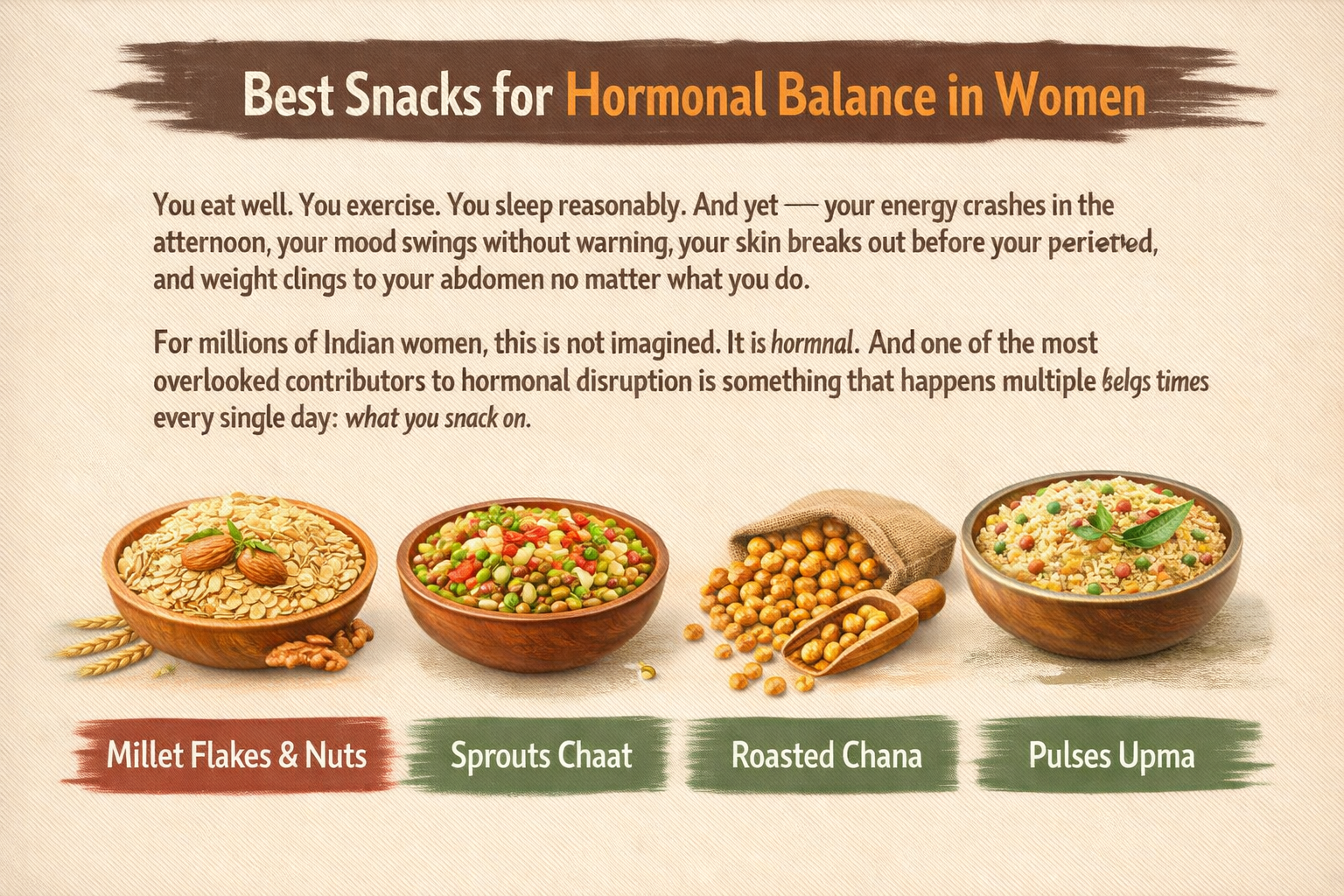
You eat well. You exercise. You sleep reasonably. And yet — your energy crashes in the afternoon, your mood swings without warning, your skin breaks out before your period, and weight clings to your abdomen no matter what you do.
For millions of Indian women, this is not imagined. It is hormonal. And one of the most overlooked contributors to hormonal disruption is something that happens multiple times every single day: what you snack on.
Hormones do not operate in isolation. They are produced from the raw materials you eat, regulated by how your blood sugar behaves, and disrupted by the inflammatory load of your diet. This means that every snacking choice — every biscuit, every packet of namkeen, every sugary energy bar — is either helping your hormonal system function or adding to its burden.
This blog explains the science behind food and hormonal balance in women, and gives you practical, specific snacking guidance to support your body — whether you are managing PCOD, navigating perimenopause, dealing with thyroid issues, or simply trying to feel more consistently well.
Understanding Women's Hormones and Why Food Matters
Women's hormonal health is governed primarily by a set of key hormones: estrogen, progesterone, testosterone (in small amounts), insulin, cortisol, and thyroid hormones. These do not work independently — they form an interconnected system where imbalance in one triggers cascades across the others.
The most common patterns of hormonal disruption in Indian women include estrogen dominance (too much estrogen relative to progesterone), insulin resistance (cells stop responding efficiently to insulin), elevated cortisol from chronic stress, thyroid underfunction (hypothyroidism), and androgen excess — the hallmark of PCOD.
What drives these imbalances? Genetics plays a role. But so do refined carbohydrates that spike blood sugar repeatedly, inflammatory seed oils found in packaged snacks, nutritional deficiencies in zinc, magnesium, B vitamins and iron, excess refined sugar that disrupts the insulin-cortisol axis, and inadequate fiber that slows estrogen excretion through the gut.
The good news is that this also means food — done right — can meaningfully support hormonal balance. And snacking, which happens 2–3 times a day for most people, is one of the highest-leverage places to make that shift.
The Hormonal Impact of Poor Snack Choices
Before we get to what helps, it's worth understanding what common Indian snacking habits do to hormones.
Refined flour biscuits and namkeen spike blood sugar rapidly. The resulting insulin surge, repeated multiple times a day, progressively worsens insulin sensitivity. In women with PCOD, insulin resistance directly stimulates the ovaries to produce excess androgens — worsening symptoms like facial hair, acne, irregular cycles, and weight gain around the abdomen.
Packaged snacks with refined sugar elevate cortisol — the stress hormone — by triggering glycemic crashes that the body reads as a mild metabolic emergency. Chronically elevated cortisol suppresses progesterone production, worsening the estrogen-to-progesterone ratio and contributing to anxiety, PMS, sleep disruption, and cycle irregularities.
Fried snacks in refined vegetable oils are rich in omega-6 fatty acids that promote inflammatory signalling. Systemic inflammation disrupts thyroid hormone conversion (T4 to active T3) and increases the enzyme aromatase, which converts androgens to estrogen — contributing to estrogen dominance.
Snacks with no fiber allow estrogen metabolites to be reabsorbed from the gut instead of being excreted, raising circulating estrogen levels over time.
The pattern is consistent: most mainstream Indian snacking actively works against hormonal balance. The alternative is not to stop snacking — it is to snack smarter.
Snacking Principles for Hormonal Balance
Before getting into specific foods and products, these are the core principles your snack choices should follow:
Keep blood sugar stable. Every snack should be low-to-moderate glycemic index. A blood sugar spike followed by a crash activates the cortisol-insulin axis — the most common hormonal disruptor in modern women's diets. Prioritise fiber-rich, protein-rich, slow-digesting snacks over anything that gives a quick rush.
Always pair carbohydrates with protein or fat. A plain rusk or plain fruit alone spikes blood sugar. The same food eaten alongside a protein source — dal, nuts, a protein-rich cookie — slows that spike significantly. Every snack should have at least one protein source.
Choose anti-inflammatory foods. Chronic inflammation is the root of most hormonal disruption — it drives insulin resistance, impairs thyroid function, worsens PCOD, and accelerates estrogen dominance. Millets, pulses, and foods rich in omega-3 are anti-inflammatory. Refined flour and seed oils are pro-inflammatory.
Prioritise fiber. The gut plays a direct role in hormone regulation — particularly estrogen. A process called the estrobolome (the gut bacteria responsible for estrogen metabolism) determines how much estrogen gets recirculated versus excreted. High-fiber foods feed the beneficial bacteria that support healthy estrogen clearance.
Avoid refined sugar. Sugar directly disrupts the cortisol-insulin relationship, worsens PCOD androgen levels, and impairs progesterone production. Jaggery — used in Nutramore's products — is a meaningfully better alternative: it retains iron, potassium, and some B vitamins, and has a gentler glycemic impact.
The Best Snack Nutrients for Each Hormonal Concern
For PCOD and Insulin Resistance
PCOD is fundamentally driven by insulin resistance in most women. The priority in snacking is low-glycemic, high-protein, high-fiber foods that prevent blood sugar spikes and support insulin sensitivity.
Jowar (sorghum) is particularly well-studied for this purpose. Its resistant starch and high fiber content help reduce the post-meal insulin response. Combined with pulse protein, jowar-based snacks provide sustained energy without triggering the insulin cascade that worsens PCOD symptoms.
Nutramore's Jowar Coconut Cookies and Jowar Chocolate Cookies are made from whole jowar flour, sweetened only with chemical-free jaggery, and contain no refined sugar or maida — making them genuinely PCOD-friendly options for mid-morning or evening snacking.
For a more substantial protein hit, the Jowar Chilla Mix provides 30g of complete protein and omega-3 fatty acids — both supportive for PCOD management — in a quick breakfast or snack that's also diabetic-friendly.
For Thyroid Health
The thyroid gland depends on iron, zinc, and selenium for the conversion of inactive T4 hormone to active T3. Iron deficiency — extremely common in Indian women — is one of the leading causes of thyroid underfunction even when TSH levels appear borderline normal.
Bajra (pearl millet) is one of the most iron-rich plant foods available in India, with approximately 8mg of iron per 100g — significantly higher than most grains and comparable to many meats on a per-calorie basis. Regular bajra consumption can meaningfully support iron levels without supplementation.
Nutramore's Bajra Cookies and Bajra Moong Chocolate Cookies combine bajra's iron richness with pulse protein, creating a snack that actively supports thyroid nutrition. Women with hypothyroidism or borderline thyroid function should consider making these a regular part of their snacking routine.
For Estrogen Balance and PMS
Excess estrogen — relative to progesterone — is one of the most common hormonal patterns in modern women. It manifests as heavy or painful periods, PMS, breast tenderness, bloating, mood changes before menstruation, and difficulty losing weight.
The most powerful dietary intervention for estrogen dominance is fiber — specifically the fiber that feeds beneficial gut bacteria responsible for estrogen excretion. Both millets and pulses are rich in this type of fiber. A diet consistently high in whole-grain millet fiber can measurably reduce circulating estrogen over time by improving gut clearance.
Calcium is also directly linked to PMS severity. Women with adequate calcium intake consistently show lower rates of PMS symptoms, mood disturbances, and menstrual cramps. Ragi is the richest plant-based calcium source in Indian cuisine — containing nearly 10 times the calcium of wheat.
Nutramore's Ragi Chocolate Cookies and Rice Ragi Cookies are among the simplest ways to increase daily calcium and fiber intake through snacking, supporting both estrogen clearance and PMS management.
For Perimenopause and Post-Menopause
As estrogen levels naturally decline during perimenopause and menopause, several nutritional needs become more acute: calcium for bone density, magnesium for sleep and mood, B vitamins for energy and nervous system function, and phytoestrogens — plant compounds that mildly mimic estrogen and can help ease the transition.
Millets and pulses deliver on all of these. Bajra and ragi are rich in magnesium and calcium. Green gram (moong) contains phytoestrogens that have been shown in research to mildly reduce hot flash frequency and improve lipid profiles in perimenopausal women.
Nutramore's Moong Almond Pistachio Cookies combine moong's phytoestrogen and protein content with the healthy fats and magnesium from almonds and pistachios — a genuinely well-rounded perimenopausal snack. The Multigrain Cookies Combo for Moms — featuring ragi, bajra, and moong — provides the full spectrum of nutrients most critical during hormonal transitions.
For Stress, Cortisol, and Adrenal Health
Chronic stress is one of the most underappreciated hormonal disruptors in women. Elevated cortisol directly suppresses progesterone, disrupts the menstrual cycle, promotes insulin resistance, and depletes magnesium — creating a vicious cycle that worsens both stress response and hormonal balance.
Magnesium is one of the most critical anti-stress minerals — it regulates the HPA axis (the body's stress-response system) and supports GABA production, the calming neurotransmitter. Bajra is notably rich in magnesium. B vitamins — abundant in pulses — are essential cofactors in cortisol metabolism and serotonin synthesis.
Snacking on high-magnesium, B-vitamin-rich foods during stressful periods is not just comforting — it is biochemically supportive. The Baked Protein Sticks from Nutramore, made from a blend of dals, provide B vitamins and complete protein in a savoury snack that works well during stressful workdays. Paired with a Bajra-based cookie for magnesium, this combination directly addresses two of the most common nutritional depletions in stressed women.
A Day of Hormone-Supporting Snacks
Here is how a day of snacking could look for a woman focused on hormonal balance:
Morning snack (10–11am): Jowar Chilla or Green-Gram Upma — high protein, low glycemic, sets stable blood sugar for the rest of the morning.
Mid-afternoon snack (3–4pm): Bajra Moong Chocolate Cookies or Moong Almond Pistachio Cookies — iron, magnesium, complete protein, and healthy fats to prevent the afternoon cortisol dip from spiralling.
Evening snack (6–7pm): Millet Methi Crispies or Baked Protein Sticks — savoury, satisfying, protein-rich, and low enough in glycemic load to not disrupt the evening cortisol wind-down.
This pattern — high-protein, high-fiber, low-glycemic, jaggery-sweetened rather than refined-sugar-sweetened — is not a special hormonal diet. It is simply the way human bodies were always meant to eat, before refined processing made cheap, damaging alternatives ubiquitous.
What to Avoid: Snacks That Actively Disrupt Hormones
As important as what to eat is what to reduce. These common snack categories consistently worsen hormonal disruption in women:
Maida-based biscuits and snacks — high glycemic, no fiber, promote insulin resistance. Refined sugar in all forms — disrupts cortisol-insulin axis, worsens PCOD androgen levels, depletes B vitamins. Fried snacks in refined vegetable oils — high omega-6 content promotes aromatase enzyme activity and estrogen excess. "Diet" snacks with artificial sweeteners — several artificial sweeteners disrupt the gut microbiome, impairing estrogen clearance and insulin response. Processed protein bars — often contain refined sugar, seed oils, and synthetic sweeteners despite marketing claims.
Final Thoughts
Hormonal balance in women is not achieved through one supplement or one dietary change. It is the cumulative result of consistent daily choices — what you eat for breakfast, what you reach for between meals, what you snack on when stress peaks at 4pm.
Millets and pulses — the foundation of traditional Indian snacking wisdom — happen to be among the most hormonally supportive foods available. They are rich in magnesium, iron, calcium, zinc, fiber, and plant protein. They are low glycemic. They are anti-inflammatory. They support estrogen clearance, progesterone production, thyroid function, and insulin sensitivity.
The challenge is making these foods convenient enough to choose consistently in a modern lifestyle — and that is precisely the gap Nutramore exists to fill.
If you are not sure where to start, the Try & Taste Trial Pack gives you 9 different millet-based flavours to explore. It is the simplest first step toward snacking that genuinely works with your body.
Explore all Nutramore products at nutramore.in/our-products
