
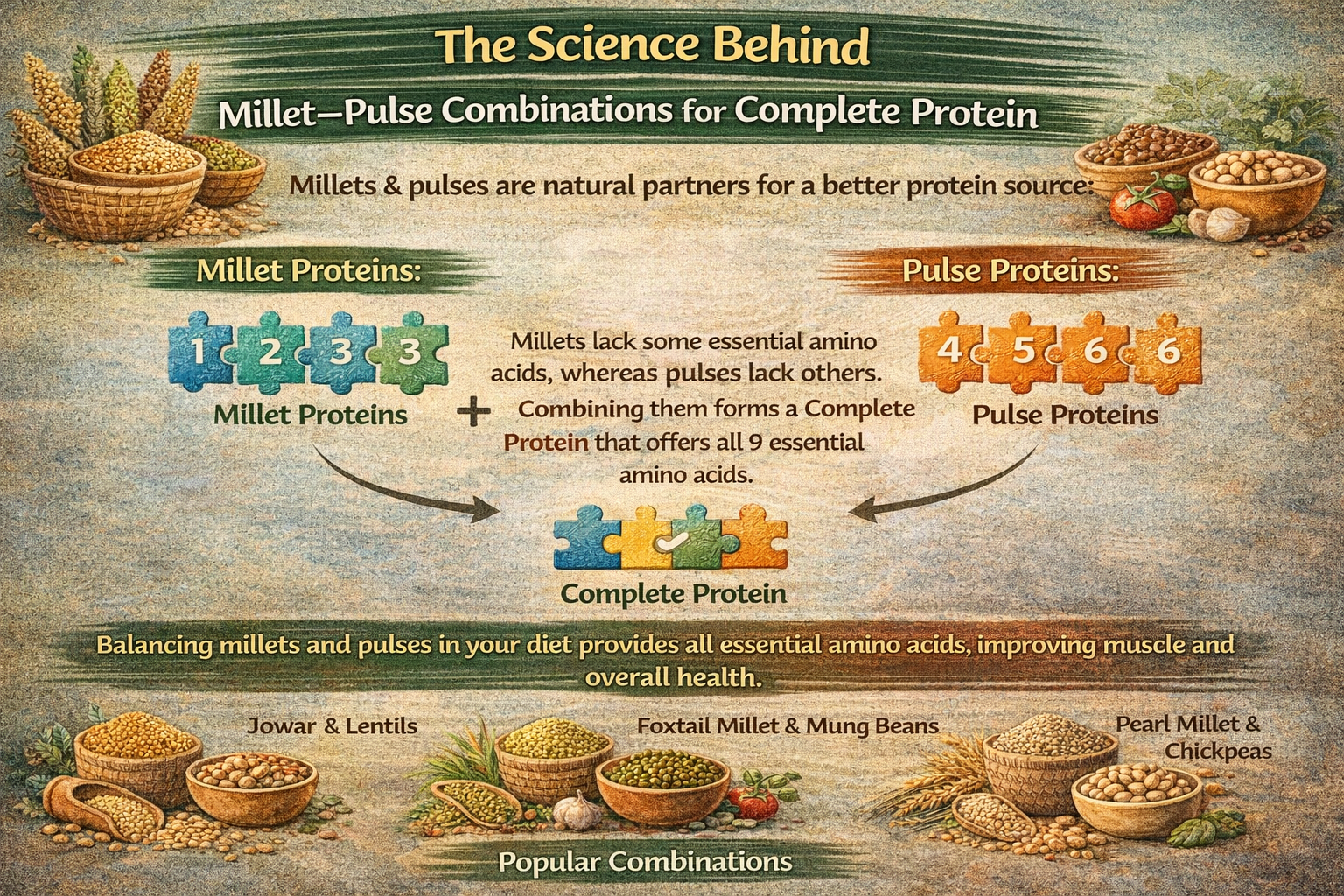
There is a reason your grandmother always served dal with jowar bhakri. Or moong with rice. Or rajma with roti made from bajra.
It wasn't just habit. It wasn't just taste. It was, unknowingly, one of the most nutritionally sophisticated eating strategies ever developed — centuries before the word "protein" even existed in any language.
Today, modern nutrition science is catching up to what traditional Indian kitchens always knew instinctively: millets and pulses, when eaten together, form a complete protein.
This single fact has enormous implications — for vegetarians, for those managing weight or muscle mass, for growing children, for seniors, and honestly for anyone eating a predominantly plant-based Indian diet.
Let's understand the science behind it properly.
First, What Is a "Complete Protein"?
Proteins are made up of building blocks called amino acids. Your body needs 20 different amino acids to function — to build muscle, repair tissue, produce enzymes, regulate hormones, and support immune function.
Of these 20, your body can manufacture 11 on its own. The remaining 9 — called essential amino acids — must come from food because your body cannot produce them.
A food is called a complete protein when it contains all 9 essential amino acids in sufficient quantities. Animal foods — meat, eggs, dairy — are naturally complete proteins. Most plant foods, however, are not.
This is where the challenge begins for vegetarians and vegans. And this is exactly where the millet–pulse combination becomes so powerful.
The Protein Gap in Plant Foods
Most plant proteins are incomplete — meaning they are deficient in one or more essential amino acids.
Millets, for example, are relatively low in lysine — one of the most critical essential amino acids, responsible for calcium absorption, immune function, and collagen production.
Pulses — lentils, moong, chana, soya, green gram — are rich in lysine. However, most pulses are low in methionine and cysteine — sulfur-containing amino acids essential for antioxidant production, liver function, and metabolism.
Here is the elegant part: the amino acid strengths of millets and pulses are almost perfectly complementary.
Where millets fall short (lysine), pulses are abundant. Where pulses fall short (methionine, cysteine), millets are strong. When you eat them together — or even at different points in the same day — your body pools the amino acids and assembles the complete set.
The result is a protein profile that rivals, and in some studies exceeds, that of many animal protein sources.
How Complementary Proteins Actually Work in the Body
V
visualize
V
visualize show_widget
https://c2bd5cbee0550fb5b12f3e9fc78ae277.claudemcpcontent.com/mcp_apps?connect-src=https%3A%2F%2Fesm.sh+https%3A%2F%2Fcdnjs.cloudflare.com+https%3A%2F%2Fcdn.jsdelivr.net+https%3A%2F%2Funpkg.com&resource-src=https%3A%2F%2Fesm.sh+https%3A%2F%2Fcdnjs.cloudflare.com+https%3A%2F%2Fcdn.jsdelivr.net+https%3A%2F%2Funpkg.com+https%3A%2F%2Fassets.claude.ai&dev=true
There is a common misconception that complementary proteins must be eaten in the exact same meal at the exact same time. Nutritional science has since clarified this: your body maintains an amino acid pool — a reserve drawn from recent meals — that lasts several hours. As long as complementary proteins are consumed within the same day, your body can assemble complete protein from them.
This means your morning Jowar Chilla and your afternoon snack of Baked Protein Sticks — made from a blend of dals — are working together in your body even though they weren't eaten simultaneously. The pairing doesn't have to be on the same plate. It just has to be in the same day.
Why India's Traditional Food Combinations Were Genius
Long before food science existed, Indian cooks empirically landed on combinations that happen to be nutritionally perfect. Consider how common these pairings are across every region of India:
Jowar bhakri + dal — Maharashtra and Karnataka. Jowar provides methionine, dal provides lysine. Complete protein, achieved.
Bajra roti + moong dal — Rajasthan. Same complementarity principle, different grains.
Idli and dosa — rice (a millet relative) fermented with urad dal. Fermentation actually increases amino acid bioavailability further, making the protein even more accessible.
Khichdi — rice and moong dal cooked together. Perhaps the most complete, easily digestible protein meal in the Indian repertoire. Not coincidentally, it is also what is fed to the sick, the elderly, and newborns transitioning to solid food.
Ragi mudde + sambar — Karnataka's traditional working-class meal. Ragi's methionine + sambar's lysine-rich toor dal = a powerhouse of complete protein that sustained generations of farmers and labourers.
These combinations didn't arise from nutritional textbooks. They arose from thousands of years of observation — noticing which food pairings gave people energy, strength, and health. Science has now given us the vocabulary to explain what the body already knew.
The Protein Bioavailability Factor
Knowing a food contains protein is only half the story. The real question is: how much of that protein does your body actually absorb and use?
This is measured by a metric called Protein Digestibility Corrected Amino Acid Score (PDCAAS) — the gold standard for assessing protein quality. It combines amino acid completeness with digestibility.
Animal proteins like eggs score close to 1.0 (the maximum). Most individual plant proteins score between 0.4 and 0.7 — meaning a significant portion passes through unabsorbed.
However, when millets and pulses are combined correctly, their combined PDCAAS rises significantly — often to 0.8–0.9, comparable to dairy protein. This is not just additive — it is synergistic. The presence of one improves the absorption of the other.
Additionally, traditional preparation methods further improve bioavailability:
Fermentation (as in idli/dosa batter) breaks down anti-nutrients like phytic acid that block mineral and protein absorption. It also pre-digests some proteins, making them easier for the gut to process.
Soaking and sprouting (common with moong and green gram) activates enzymes that reduce anti-nutrients and increase the bioavailability of both protein and minerals.
Baking at moderate temperatures (as opposed to deep-frying) preserves amino acid integrity without the oxidative damage caused by high-heat frying.
This is why Nutramore's baked approach — using whole millet flours and pulse-based ingredients, without deep-frying — preserves the nutritional intelligence of the original ingredients.
What This Means for Different Life Stages
For growing children
Children need protein not just for muscle — but for brain development, immune system formation, and bone mineralisation. Lysine (abundant in pulses) is critical for growth hormone activity and calcium absorption. Methionine (strong in millets) supports liver function and cellular repair.
A child eating Nutramore's Sugar-Free Toddler Combo — combining ragi, moong, and rice cookies — is getting a remarkably complete amino acid profile in a format they will actually enjoy eating.
For pregnant and breastfeeding women
Protein requirements increase by 25–30% during pregnancy. The amino acid leucine, found in pulses, directly stimulates fetal muscle protein synthesis. Methionine, strong in millets, supports placental development and fetal brain growth.
The Multigrain Cookies Combo for Moms — combining ragi, bajra, and moong — was curated specifically with this nutritional reality in mind.
For vegetarians and vegans
This is perhaps the group with the most to gain. The persistent concern about vegetarian diets is protein adequacy — specifically the completeness of amino acid profiles. The millet–pulse combination directly solves this problem without any animal products.
Nutramore's Bajra Moong Chocolate Cookies bring this combination into a convenient snack format — bajra's sulfur amino acids paired with moong's lysine richness, baked together into one product. The protein work is done before you even open the packet.
For active adults and fitness enthusiasts
Muscle protein synthesis requires leucine as a trigger amino acid — and it requires the full spectrum of essential amino acids to complete the process. Without a complete amino acid profile, the body cannot maximally build or repair muscle tissue even when total protein intake looks adequate on paper.
For workout recovery, Baked Protein Sticks — 18g of protein from a flavourful dal blend — offer a post-workout snack that delivers complete amino acids without whey powder, artificial flavours, or processed sugars.
Pair them through the day with a millet-based breakfast like Jowar Chilla Mix (30g protein, complete amino acid profile, omega-3 rich) and you have a genuinely athlete-grade plant protein strategy.
For seniors
Protein requirements actually increase with age due to a phenomenon called anabolic resistance — the body becomes less efficient at using dietary protein to build and maintain muscle. This makes the quality and completeness of protein even more critical in older adults.
Sarcopenia (age-related muscle loss) is closely linked to inadequate complete protein intake, and is one of the leading contributors to falls, fractures, and loss of independence in seniors. The millet–pulse combination — rich in leucine, lysine, and methionine — directly addresses this.
Green-Gram Upma Premix with 32g of complete protein per serve, developed in consultation with veteran nutritionists, is an outstanding high-protein breakfast for older adults — easy to prepare, gentle on digestion, and deeply nourishing.
The Anti-Nutrient Conversation
A common criticism of plant-based proteins is the presence of anti-nutrients — compounds like phytic acid, tannins, and oxalates that bind to minerals and proteins and reduce their absorption.
Millets and pulses do contain some anti-nutrients. But here's what critics often overlook:
Traditional Indian food preparation methods were specifically designed — again, empirically, over centuries — to neutralise these anti-nutrients. Soaking, sprouting, fermenting, and cooking with heat all significantly reduce phytic acid and other binding compounds.
Nutramore's baking process applies moderate heat that is effective at reducing phytic acid content without damaging heat-sensitive amino acids. The result is a snack that offers better amino acid bioavailability than a raw grain would, while retaining the structural integrity of the protein.
A Note on Protein Quantity vs. Protein Quality
The Indian health conversation has become obsessed with protein quantity — how many grams per day, how many grams per serve. But quantity without quality is meaningless.
Eating 30g of protein from an incomplete source is nutritionally inferior to eating 20g from a complete source, because the body cannot use incomplete protein for muscle synthesis — it either converts the excess to energy (and fat if surplus) or excretes it.
This is why the millet–pulse combination isn't just about eating more protein. It is about eating usable protein — protein that the body can actually deploy for building, repairing, and sustaining every system that depends on amino acids.
The Breakfast Premix Combo — combining Green-Gram Upma, Jowar Upma, and Jowar Chilla Mix — is built on exactly this principle. Three different millet–pulse pairings, each delivering complete protein, each ready in minutes.
Bringing It All Together
The science is clear, the tradition is deep, and the practical path forward is straightforward:
Eat millets. Eat pulses. Eat them together, or across the same day. Your body will do the rest.
What Nutramore has done is take this ancient wisdom — validated by modern nutritional science — and make it genuinely convenient for the pace of modern life. No elaborate cooking. No nutritional compromise. No hunting through ingredient lists for hidden maida or refined sugar.
Just real grains, real pulses, baked carefully, sweetened with jaggery — delivering the complete protein your body was designed to thrive on.
Explore all Nutramore products at nutramore.in/our-products