You offer your child a bowl of fruit. They want a biscuit. You serve a nutritious lunch. They ask for something sweet after two bites. You try to cut back on packaged snacks. The result is tears, negotiation, and eventually — you give in because the alternative feels like a battle you don't have the energy for today.
If this sounds familiar, you are not failing as a parent. You are up against something much bigger than willpower or discipline — yours or your child's.
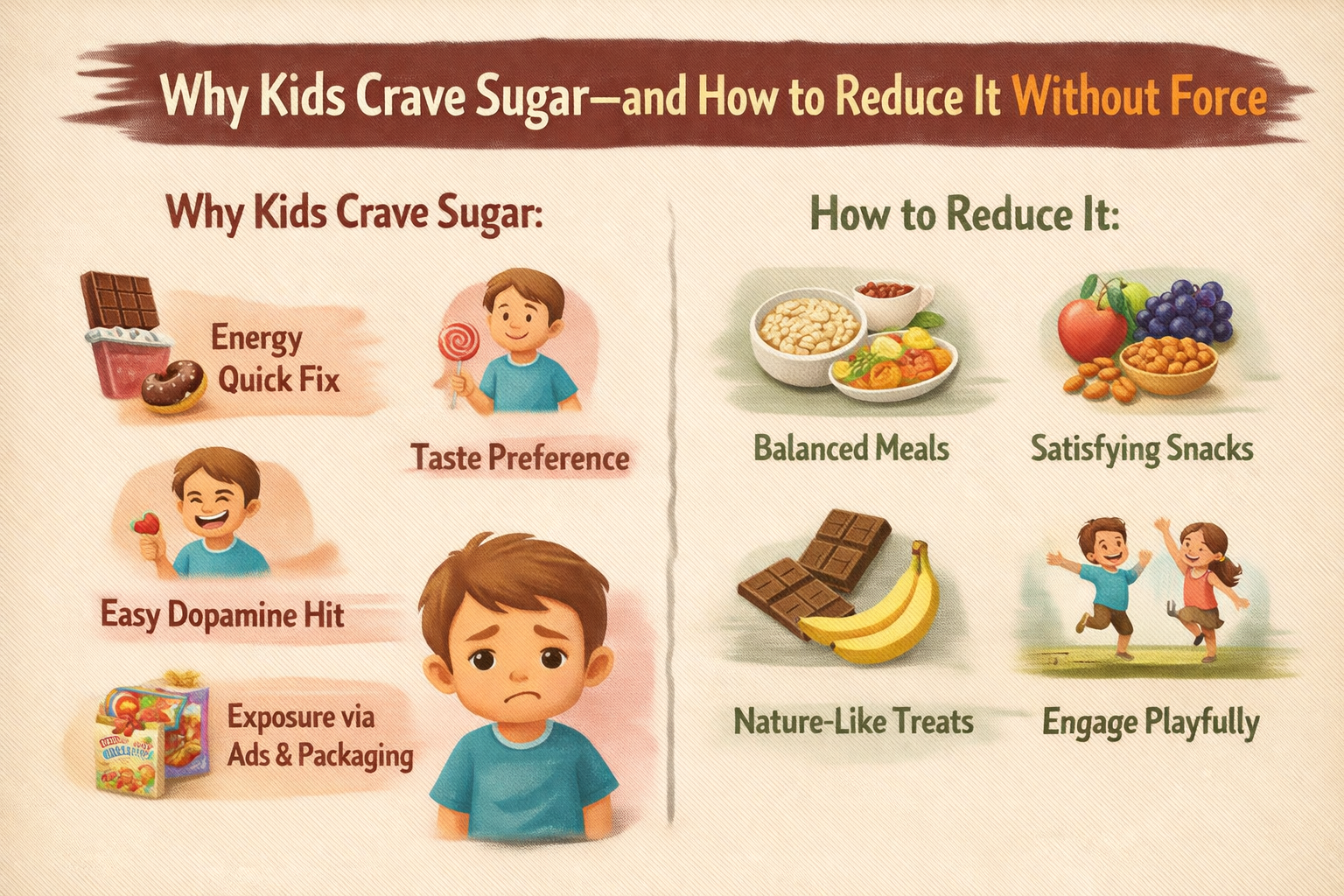
Children's sugar cravings are not a character flaw or a result of bad parenting. They are the product of neuroscience, biology, food industry engineering, and the way the modern food environment has been deliberately designed to override a child's natural appetite signals.
Understanding why the craving exists — really understanding it, not just knowing that sugar is "bad" — is the first step to changing it. And the second step is knowing that it can be changed, gently and effectively, without turning mealtimes into conflict zones.
The Biology Behind Why Children Crave Sugar More Than Adults
Children are not simply small adults with bad taste preferences. Their relationship with sugar is fundamentally different from an adult's — driven by biology, not choice.
Growth requires glucose. The developing brain and body of a child have extraordinarily high energy demands. The brain alone accounts for up to 60% of a child's resting metabolic rate — compared to about 20% in adults. The brain's preferred fuel is glucose. Evolution, accordingly, has wired children to seek sweet foods, because for most of human history, sweet meant safe, calorie-dense, and energy-rich.
Children have more taste receptors for sweetness. Research published in the journal Physiology & Behavior has documented that children have a significantly higher density of sweet taste receptors and a higher activation threshold — meaning they need more sweetness to register the same level of satisfaction an adult would feel from a smaller amount. This is not preference — it is anatomy.
The dopamine response is stronger. Studies using neuroimaging have shown that the brain's reward circuit responds more intensely to sweet tastes in children than in adults. The dopamine hit from sugar is, for a child, comparable to the dopamine response adults get from powerful stimuli. This is why denying a child sugar can feel to them like something genuinely distressing — because neurologically, it is.
They haven't developed the "off switch" yet. The prefrontal cortex — responsible for impulse control, delayed gratification, and evaluating long-term consequences — doesn't fully mature until the mid-20s. A child literally cannot reason themselves out of a sugar craving the way an adult can, because the brain circuitry required for that isn't fully built yet.
This does not mean nothing can be done. It means that the solution cannot rely on asking a child to resist a biological drive through willpower. It must work with the biology, not against it.
How the Food Industry Makes It Worse
If the biology was the whole story, children's sugar cravings would be manageable — because traditional Indian diets, with naturally sweet foods like fruits, jaggery, and fresh coconut, satisfied that sweet drive without creating dependency.
The modern food industry has changed the equation entirely.
Packaged biscuits, instant noodles, flavoured milk, "fruit" drinks, breakfast cereals, and children's snack bars are engineered to hit what food scientists call the "bliss point" — the precise combination of sugar, fat, and salt that maximises palatability and minimises satiety. Foods designed to this formula are specifically calibrated to override the body's fullness signals, ensuring the child keeps eating.
Ultra-processed children's snacks typically contain refined sugar, refined flour (maida), artificial flavours, and synthetic colours — each of which has a documented effect on children's behaviour, attention, and appetite regulation. The combination of refined sugar and refined flour creates a glycemic spike that temporarily satisfies, then drops the child into a blood sugar crash that triggers another intense craving — often within 30–45 minutes of eating.
The result is a child who appears to have an insatiable sweet tooth, but who is actually trapped in a blood sugar roller coaster created entirely by the type of food they're eating, not the amount.
This is the critical insight: it is not how much sugar children eat that primarily drives cravings — it is the type of sugar and the food matrix it comes in.
The Blood Sugar Roller Coaster Explained
Understanding glycemic response is key to understanding children's cravings. Here is what happens in a child's body when they eat a refined sugar snack:
Blood sugar rises rapidly — the child feels a brief burst of energy, mood lift, and satisfaction. The pancreas releases a large amount of insulin to bring blood sugar back down. Blood sugar drops — often below the starting point — triggering physical symptoms the child experiences as intense hunger, irritability, difficulty concentrating, and craving for more sugar. The child asks for another sweet snack. The cycle repeats.
This pattern, repeated multiple times daily across months and years, does two things: it trains the brain to associate sweet food with mood relief, and it progressively impairs the metabolic machinery that regulates hunger and satiety — making cravings stronger over time, not weaker.
Breaking this cycle requires replacing the high-glycemic snacks that drive it with low-glycemic, fiber-rich, protein-rich alternatives that deliver slower, steadier energy — without triggering the crash that demands more sugar.
Why Force Doesn't Work — and Often Backfires
Many parents' instinct when they identify a sugar problem is to restrict: no more biscuits, no sweets, no dessert until you eat your vegetables. This approach is understandable but consistently counterproductive for several well-documented reasons.
Restriction increases the perceived value of forbidden foods. Research by psychologist Dr. Leann Birch — one of the world's leading authorities on children's eating behaviour — has shown repeatedly that when children are told they cannot have a food, that food becomes more desirable, not less. Children who grow up in households with heavy food restriction consistently show higher rates of disordered eating in adolescence and adulthood.
It disrupts trust signals. Children are born with a functional ability to self-regulate food intake — they eat when hungry and stop when full. Heavy parental control over food overrides this system, teaching the child to eat based on external rules rather than internal signals. This contributes to binge eating patterns and difficulty recognising hunger and satiety cues throughout life.
It creates stress associations with food. Negative emotions around eating — guilt, anxiety, conflict — set the stage for a psychologically unhealthy relationship with food that can persist for decades.
It doesn't address the root cause. Restriction removes access to the problem food, but it doesn't change the blood sugar patterns, the dopamine wiring, or the gut microbiome that drive the craving in the first place.
The evidence-based approach is substitution, not restriction — gradually replacing the foods that drive cravings with foods that satisfy the same sweet drive while delivering genuine nutrition and stabilising blood sugar.
How to Reduce Sugar Cravings Without Force: Practical Strategies
1. Replace, Don't Remove
The most effective strategy is not to take away — it is to offer something better that the child genuinely enjoys. This requires finding alternatives that are truly satisfying and sweet enough to feel like a treat, not a punishment.
Millet-based cookies sweetened with jaggery are one of the best tools available for this. They satisfy the sweet drive, have a pleasant taste and texture that children genuinely enjoy, and deliver a fundamentally different glycemic and nutritional response compared to refined flour biscuits.
Nutramore's Ragi Chocolate Cookies, Jowar Chocolate Cookies, and Bajra Moong Chocolate Cookies are specifically valuable here because they carry the chocolate flavour that children consistently prefer — but deliver it via jaggery sweetness, millet fiber, and pulse protein rather than refined sugar and maida. The child experiences "I got my chocolate treat." The parent knows the blood sugar response is entirely different.
2. Change the Snack Timing
When a child has gone more than 3–4 hours without food, blood sugar is already low and the craving for a rapid sugar fix becomes intense and almost impossible to redirect. Preventing this low is easier than managing the craving once it hits.
Offering a balanced snack proactively — before hunger becomes extreme — dramatically reduces the intensity of sugar cravings. A mid-morning snack around 10am and a planned afternoon snack around 4pm are the two most critical intervention points in a child's day.
3. Pair Sweet Snacks with Protein or Fiber
If a child wants something sweet, the glycemic impact of that food can be significantly reduced by pairing it with protein or fiber. A jaggery-sweetened millet cookie eaten alongside a small handful of nuts, or a piece of fruit eaten after a protein-rich snack, delivers a far gentler blood sugar response than the same food eaten alone.
This pairing strategy does not require restricting the sweet food — it simply changes the metabolic context in which it is consumed.
4. Introduce Savoury Snacks at Snack Time
One of the most effective ways to reduce sweet dependence is to expand the child's snack repertoire to include satisfying savoury options. Children who regularly snack on well-flavoured savoury foods gradually develop less automatic reaching for sweet.
Nutramore's Millet Methi Crispies and Baked Protein Sticks work well here — they are flavourful, crunchy (the texture children typically crave from packaged snacks), high in protein, and baked rather than fried. The crunch-and-flavour satisfaction they deliver reduces the sensory craving that drives much of children's snacking behaviour.
5. Let the Child Experience the Difference
Children are far more self-aware than adults give them credit for, especially when it comes to physical sensation. Many children, once helped to notice the difference, can identify that some snacks make them feel energetic and satisfied while others lead to crashes.
This is not a lecture — it is a gentle, curious conversation. "How do you feel after eating those biscuits?" "Did you feel hungry again quickly?" "How does this feel compared to yesterday's snack?" Helping children develop interoceptive awareness — the ability to notice internal body signals — is one of the most powerful long-term tools for reducing sugar dependence.
6. Make the Healthy Option the Easy Option
Children eat what is available. If the pantry contains refined flour biscuits and chips, that is what they will reach for. If it contains millet cookies, baked protein sticks, and jaggery-sweetened snacks, those become the default.
This is environmental design, not restriction. The child is not being told they cannot have something — the environment simply makes the better choice the path of least resistance. This is the single most effective structural change most families can make.
What to Look for in a Child-Friendly Healthy Snack
Not all snacks marketed as "healthy" or "natural" are equally appropriate for children. Here is a simple checklist parents can apply:
No refined flour (maida) — the base should be whole grain, millet, or pulse-based. No refined white sugar — jaggery, dates, or fruit-based sweetness is meaningfully better. Adequate protein — at least 2–3g per serving to support satiety and stabilise blood sugar. Fiber from whole ingredients — not added inulin or chicory root, but natural fiber from the grain itself. No artificial colours or flavours — these have documented links to hyperactivity and attention difficulties in children. Appropriate texture and taste — a snack a child doesn't enjoy will not replace a snack they love, no matter how nutritious it is.
Nutramore's entire cookie range meets all of these criteria. Eggless, made with fresh butter, sweetened only with chemical-free jaggery, and built on whole millet and pulse bases — they are designed to be genuinely enjoyable for children while being nutritionally sound for parents.
For families with toddlers and young children, the Sugar-Free Cookies Combo for Toddlers — combining Ragi, Moong, and Rice cookies — is specifically formulated for small children: easily digestible, calcium and protein-rich, and sweet enough to satisfy without any refined sugar.
For older children and families wanting variety, the All-Time Favourite Cookies Combo — Jowar, Rice-Ragi, and Bajra cookies — provides flavour variety across the three most popular millet bases, keeping snack time interesting without reverting to refined snacks.
And if you are not sure where to start, the Try & Taste Trial Pack with 9 different mini flavours is the lowest-pressure way to find out which ones your child naturally reaches for.
The Gut Microbiome Connection
There is one more layer to children's sugar cravings that is only recently being understood in nutritional science: the role of the gut microbiome.
The bacteria in the gut do not just digest food — they communicate with the brain via the gut-brain axis, influencing mood, appetite, and cravings. Certain bacteria species — particularly those that thrive on refined sugar — produce signals that the brain interprets as hunger for more sugar. In other words, a gut microbiome dominated by sugar-feeding bacteria will actively generate sugar cravings in the child.
Conversely, fiber-rich foods — particularly the resistant starch and prebiotic fibers found in millets and pulses — feed beneficial bacteria that produce short-chain fatty acids (SCFAs), which improve insulin sensitivity, reduce appetite dysregulation, and support a more stable mood and energy state.
This means that consistently feeding children fiber-rich millet and pulse-based snacks does not just avoid sugar spikes in the short term — it gradually reshapes the gut microbiome in a way that reduces sugar cravings from the inside out, over weeks and months.
This is the most compelling long-term argument for making the switch: it gets easier over time. The first two weeks may require some adjustment. But as the gut microbiome shifts, the cravings genuinely diminish — not because the child has been forced to resist them, but because the biological drive itself has changed.
A Note on Jaggery vs Refined Sugar
Many parents switch to jaggery-sweetened products and wonder whether it is genuinely different or just marketing. The distinction is real and meaningful for children.
Refined white sugar is sucrose stripped of all nutritional content — pure glycemic load, zero micronutrients. Jaggery retains iron, potassium, calcium, magnesium, and some B vitamins from the original sugarcane. It has a slightly lower glycemic index than refined sugar. And crucially, it does not contain the phosphoric acid and bleaching agents present in refined white sugar processing.
For children who are iron-deficient — an extremely common finding in Indian paediatric health assessments — jaggery-sweetened foods are actually contributing a trace but real amount of dietary iron with every serving, rather than delivering empty calories.
This does not make jaggery a health food in unlimited quantities. But in the context of a well-formulated millet-based cookie, jaggery is a meaningfully better sweetener than refined sugar — for children's blood sugar, micronutrient status, and gut health.
Final Thoughts
Children crave sugar because evolution built them that way, the food industry exploits it, and the refined snacks they eat every day make the craving stronger with every cycle.
The solution is not willpower, restriction, or conflict. It is understanding, substitution, and patience.
Replace refined snacks with millet-based alternatives that satisfy the same sweet craving with better ingredients. Change the home food environment so the healthy choice is the easy choice. Help your child connect to how different foods make them feel. Give the gut microbiome time to shift.
None of this requires a perfect diet or a battle at every meal. It requires small, consistent changes — starting with what is in the snack drawer.
Explore Nutramore's full range of child-friendly millet snacks at nutramore.in/our-products