You are in a supermarket, comparing two packets of biscuits. One says "No Preservatives" in bold green letters on the front. It feels like the responsible choice. It goes into the cart.
But here is what that label did not tell you: the biscuit may still contain refined wheat flour that spikes blood sugar more aggressively than table sugar. It may contain partially hydrogenated fat — a source of trans fatty acids linked to cardiovascular disease. It may contain artificial colours that are associated with hyperactivity in children. It may contain flavour enhancers that override natural appetite signals. And it may contain enough refined sugar to account for most of a child's recommended daily intake in a single serving.
None of these ingredients are preservatives. The claim "No Preservatives" does not cover any of them. And yet, the label has done its job — it created the impression of a clean, trustworthy product without making a single false statement.
This is how food label marketing works in practice. Not through outright lies, but through the strategic deployment of true-but-incomplete claims that redirect attention from what matters to what sounds good.
Understanding what "No Preservatives" actually means under Indian food law — what it covers, what it deliberately does not cover, and what other ingredients it coexists with in products that carry the claim — is one of the most practical pieces of food label literacy any consumer can have.
What Preservatives Actually Are — The Legal Definition
In Indian food law, regulated by the Food Safety and Standards Authority of India (FSSAI) under the Food Safety and Standards (Food Products Standards and Food Additives) Regulations, 2011, preservatives are defined as a specific category of food additives whose purpose is to prevent or retard the deterioration of food — specifically by inhibiting microbial growth, oxidation, or enzymatic activity that would cause spoilage.
FSSAI maintains a permitted list of preservatives that manufacturers may use in food products. The most common ones you will encounter on Indian food labels include:
Sodium benzoate (E211) — used in beverages, jams, sauces, and some packaged snacks to inhibit the growth of bacteria, yeast, and fungi. In an acidic environment (such as a fruit drink), sodium benzoate can react with ascorbic acid (vitamin C) to form benzene — a known carcinogen.
Potassium sorbate (E202) — used in baked goods, cheese, dried fruits, and many packaged snacks to inhibit mould and yeast growth. Generally considered one of the safer preservatives, though some individuals report sensitivity reactions.
Sodium nitrite (E250) and sodium nitrate (E251) — used primarily in processed meats to prevent the growth of Clostridium botulinum and to maintain the pink colour associated with cured products. Nitrites can form nitrosamines — compounds associated with increased cancer risk — particularly at high cooking temperatures.
TBHQ (tert-butylhydroquinone, E319) — a synthetic antioxidant preservative used in oils and fried snacks to prevent rancidity. At high doses in animal studies, TBHQ has been associated with adverse effects; at the levels used in food, regulatory bodies consider it safe, but many nutritionists recommend avoiding it as a precautionary measure.
BHA (butylated hydroxyanisole, E320) and BHT (butylated hydroxytoluene, E321) — synthetic antioxidants used to preserve fats and oils. BHA is classified as a possible human carcinogen by the International Agency for Research on Cancer (IARC). BHT has been associated with endocrine disruption in animal studies.
Sulphur dioxide (E220) and sulphites (E221–E228) — used in dried fruits, wines, and some processed foods to prevent browning and microbial growth. Can cause adverse reactions in asthmatic individuals, sometimes severely.
When a product says "No Preservatives," it means none of the above ingredients — or any other substance classified as a preservative under FSSAI regulations — is present in the formulation.
This is a meaningful thing to know. It is not a meaningless claim. Products without sodium benzoate, TBHQ, or sulphites are genuinely different from products that contain them.
The problem is that "No Preservatives" has become shorthand for "clean ingredient list" in consumer perception — and these are very different things.
What "No Preservatives" Does Not Cover
This is the core of what most consumers do not understand — and what food manufacturers are entirely aware of.
The "No Preservatives" claim speaks only to one category of food additive. It says nothing about any of the following categories, each of which can be present in a product carrying the claim and each of which has its own documented effects on health:
Artificial Colours
Artificial colours are not preservatives. A product can contain no preservatives and still include tartrazine (E102), sunset yellow (E110), allura red (E129), brilliant blue (E133), or carmoisine (E122) — all of which are permitted under FSSAI regulations in specific food categories.
The concern with artificial colours, particularly in the context of children's food, is well-documented. A landmark study published in The Lancet in 2007 — the McCann et al. study commissioned by the UK Food Standards Agency — found that a mixture of six artificial food colours (the "Southampton Six," which includes tartrazine and sunset yellow) combined with sodium benzoate significantly increased hyperactive behaviour in children aged 3 and 8–9. This study prompted the European Food Safety Authority to recommend warning labels on foods containing these colours, stating that they "may have an adverse effect on activity and attention in children."
In India, these colours remain permitted in many food categories without mandatory warning labels. They appear regularly in packaged children's snacks — including many that carry prominent "No Preservatives" front-of-pack claims.
Artificial Flavours and Flavour Enhancers
"Natural flavour" and "artificial flavour" are broad categories that cover a vast range of chemical compounds, none of which are preservatives. A product can be preservative-free and still contain monosodium glutamate (MSG, E621), disodium inosinate (E631), disodium guanylate (E627), or any number of synthetic flavour compounds designed to make food taste more intensely appealing than its underlying ingredients would naturally produce.
Flavour enhancers are particularly significant because they specifically override natural appetite regulation. MSG, for example, activates umami receptors in a way that signals reward to the brain and suppresses the satiety signals that would ordinarily indicate the food has been consumed. This is not a conspiracy theory — it is the documented pharmacological mechanism of glutamate receptors in the hypothalamus, which is precisely why MSG was patented and sold specifically to make food more palatable and consumable.
The presence of flavour enhancers in a "No Preservatives" product means the product has been engineered to be eaten beyond natural appetite — regardless of how clean its preservative status appears.
Refined Sugar
Refined white sugar is not a preservative. A product can contain no preservatives and still list sugar as its second ingredient — meaning sugar is present by weight in greater quantity than almost everything else in the formulation.
The metabolic consequences of refined sugar — blood glucose spikes, insulin surges, fat storage signals, ghrelin rebounds, progressive insulin resistance — are entirely unrelated to preservative status. A sugar-heavy product is metabolically problematic whether or not it contains sodium benzoate.
This is perhaps the most consistent gap between "No Preservatives" and actual health quality. Many of the most aggressively marketed "No Preservatives" children's biscuits contain 8–12g of refined sugar per serving — a figure that accounts for a substantial proportion of a child's recommended daily sugar intake, and that produces the blood sugar cycling responsible for sugar cravings, energy crashes, and progressive insulin resistance — entirely independent of the preservative-free claim.
Refined Wheat Flour (Maida)
Maida is not a preservative. A product can contain no preservatives and be entirely based on refined wheat flour — a high-glycemic carbohydrate source stripped of its bran, germ, and essentially all micronutrient content.
Maida has a glycemic index of approximately 70–80 — firmly in the high range — and contains less than 1g of dietary fiber per 100g. In children's snacks, maida delivers rapid blood glucose spikes, minimal satiety, no meaningful micronutrient contribution, and the gut microbiome-disrupting effects of a low-fiber, refined carbohydrate.
None of this is addressed by the "No Preservatives" claim. A maida-based biscuit without preservatives is a cleaner chemical formulation than a maida-based biscuit with sodium benzoate — but it is the same metabolic problem, and in most cases a similar nutritional non-entity.
Partially Hydrogenated Fats and Trans Fatty Acids
Partially hydrogenated vegetable oil — sold in India as vanaspati — is not a preservative. A product can contain no preservatives and still list vanaspati or partially hydrogenated fat as an ingredient.
Trans fatty acids, produced through the partial hydrogenation process, are among the most definitively harmful dietary components identified in nutritional research. The evidence that trans fats increase LDL cholesterol, reduce HDL cholesterol, promote systemic inflammation, and increase cardiovascular disease risk is so strong that the WHO has set a global target of eliminating industrially produced trans fats from the food supply.
FSSAI has moved to limit trans fats in Indian food products — regulations now cap trans fat content at 2% of total fat in edible oils and fats. However, products may still contain small amounts under this threshold and carry no warning, while legitimately claiming "No Preservatives."
In practice, the "No Preservatives" claim and the presence of partially hydrogenated fat are not mutually exclusive — and the latter is far more damaging than most preservatives at the levels typically used in food.
Excessive Salt (Sodium)
Salt is not a preservative in the regulatory classification — though it has preserving properties at high concentrations. A product can be preservative-free and contain sodium levels that contribute meaningfully to hypertension risk.
Many savoury packaged snacks that carry "No Preservatives" claims contain 400–600mg of sodium per serving — 17–26% of the daily recommended upper limit for adults in a single snack. For children, whose recommended limits are lower, the proportion is higher still.
The Marketing Architecture of "Clean" Label Claims
Understanding "No Preservatives" is most useful in the broader context of how packaged food marketing assembles health claims to create impressions that exceed the literal truth of any individual statement.
Modern food marketing operates through what researchers have called the "health halo effect" — the documented tendency for a single health-related claim on a product to cause consumers to evaluate the entire product more favourably than the full nutritional profile would warrant. A product with "No Preservatives" on the front is perceived as healthier, more natural, and more trustworthy than a nutritionally identical product without the claim — even by consumers who intellectually understand that the claim is limited.
Manufacturers know this. The combination of claims like "No Preservatives," "Baked Not Fried," "Contains Calcium," and "No Artificial Colours" on the same front-of-pack creates a cumulative health impression that may be entirely consistent with a product whose ingredient list begins with maida and refined sugar, contains partially hydrogenated fat, uses artificial flavours, and delivers a glycemic response comparable to candy.
Each individual claim may be technically true. The composite impression is the deception.
The front of the pack is a marketing document, governed by broadly permissive rules about what can be claimed as long as it is technically accurate. The ingredient list and nutrition panel on the back are the legal disclosure. The relationship between the front and the back of many packaged food products — particularly children's snacks — is the most revealing thing you can look at in a supermarket aisle.
The FSSAI Framework: What Indian Law Requires and What It Doesn't
Understanding where the FSSAI's regulatory framework is strong and where its current limitations leave consumers exposed is important for reading Indian food labels accurately.
What FSSAI does well:
FSSAI mandates a nutritional information panel on most packaged foods, listing energy, total fat, saturated fat, trans fat, carbohydrates, sugars, protein, and sodium per 100g and per serving. It requires ingredients to be listed in descending order by weight — which, as discussed in the food label reading blog, is the single most informative piece of information on the back of any pack. It maintains a permitted additives list with specified maximum levels for each additive. And it has progressively tightened trans fat limits — the 2% cap on trans fats in edible oils represents genuine regulatory progress.
Where gaps remain:
FSSAI does not currently require front-of-pack warning labels on products with high sugar, salt, or saturated fat content — a measure that many nutritional health bodies globally recommend and that several countries have implemented. India's front-of-pack labelling reforms have been discussed and delayed multiple times.
FSSAI does not restrict health claims on products that are nutritionally poor by any meaningful measure — a manufacturer can claim "contains iron" on a product that is primarily refined sugar and maida, and the claim is legally compliant as long as the product contains some iron.
FSSAI does not mandate disclosure of specific flavour compounds under "natural flavour" — the catch-all category that can include hundreds of chemical compounds that would concern many consumers if listed by name.
And critically, FSSAI does not regulate the cumulative impression created by the combination of front-of-pack claims — only the individual technical accuracy of each claim in isolation. The gap between individual claim accuracy and composite impression is where most food marketing manipulation occurs.
This is not a criticism of FSSAI specifically — these gaps exist in food regulatory frameworks globally. It is simply the current landscape that makes consumer food label literacy an essential personal skill rather than something that can be fully delegated to regulatory protection.
What Genuine Ingredient Cleanliness Actually Looks Like
Given everything above, what does a genuinely clean ingredient list look like — not in terms of preservative status specifically, but in terms of overall food quality?
A genuinely clean snack product has:
A short ingredient list — ideally under ten ingredients. The more ingredients a product contains, the more likely it is to include functional additives whose purpose is to compensate for low-quality base ingredients — binders, emulsifiers, flavour compounds, texture agents. A product with five or six recognisable ingredients generally does not need the additives that a product with fifteen requires.
Whole food first ingredients. Whatever appears first on the ingredient list is present in the greatest quantity. A genuinely whole-food snack has a recognisable food — a millet flour, a pulse flour, a nut, butter — as its first ingredient. Not "refined wheat flour (enriched with iron and B vitamins)" — which is still refined flour, with the nutritional intervention flagged as a selling point precisely because the refining process removed those nutrients in the first place.
A sweetener you recognise and can source yourself. Jaggery, dates, coconut sugar, or honey — these are sweeteners with an independent identity, a traceable origin, and some nutritional co-content beyond pure sweetness. "Sugar," "glucose," "dextrose," "invert sugar," "corn syrup," "maltose" — these are industrial sweeteners whose presence in the first five ingredients of a children's snack is a clear nutritional concern, preservative-free or not.
No ingredient names that require a chemistry degree. If you cannot identify what an ingredient is from its name, it is an additive — a functional chemical added for a specific technological purpose. Some additives are entirely benign (lecithin, for example, is a natural emulsifier from soya or sunflower). Others — TBHQ, BHA, tartrazine, sodium benzoate — warrant the caution the "No Preservatives" marketing implicitly capitalises on while failing to address.
Real fat — not partially hydrogenated. Butter, cold-pressed coconut oil, cold-pressed groundnut oil, ghee — these are fats with names that correspond to actual foods. "Refined vegetable oil," "partially hydrogenated fat," and "vanaspati" are processing outputs whose trans fat and oxidation profile is meaningfully different from whole food fats.
Nutramore's Approach: What Transparency in Labelling Actually Looks Like
The reason Nutramore's product formulation is worth examining in this context is not as a brand endorsement but as a concrete illustration of what a genuinely clean ingredient list looks like in practice — and how the absence of a long list of health claims can itself be a form of confidence.
Nutramore's products carry no "No Preservatives" front-of-pack badge. They do not need to — because the ingredient list makes the situation immediately clear without the marketing layer.
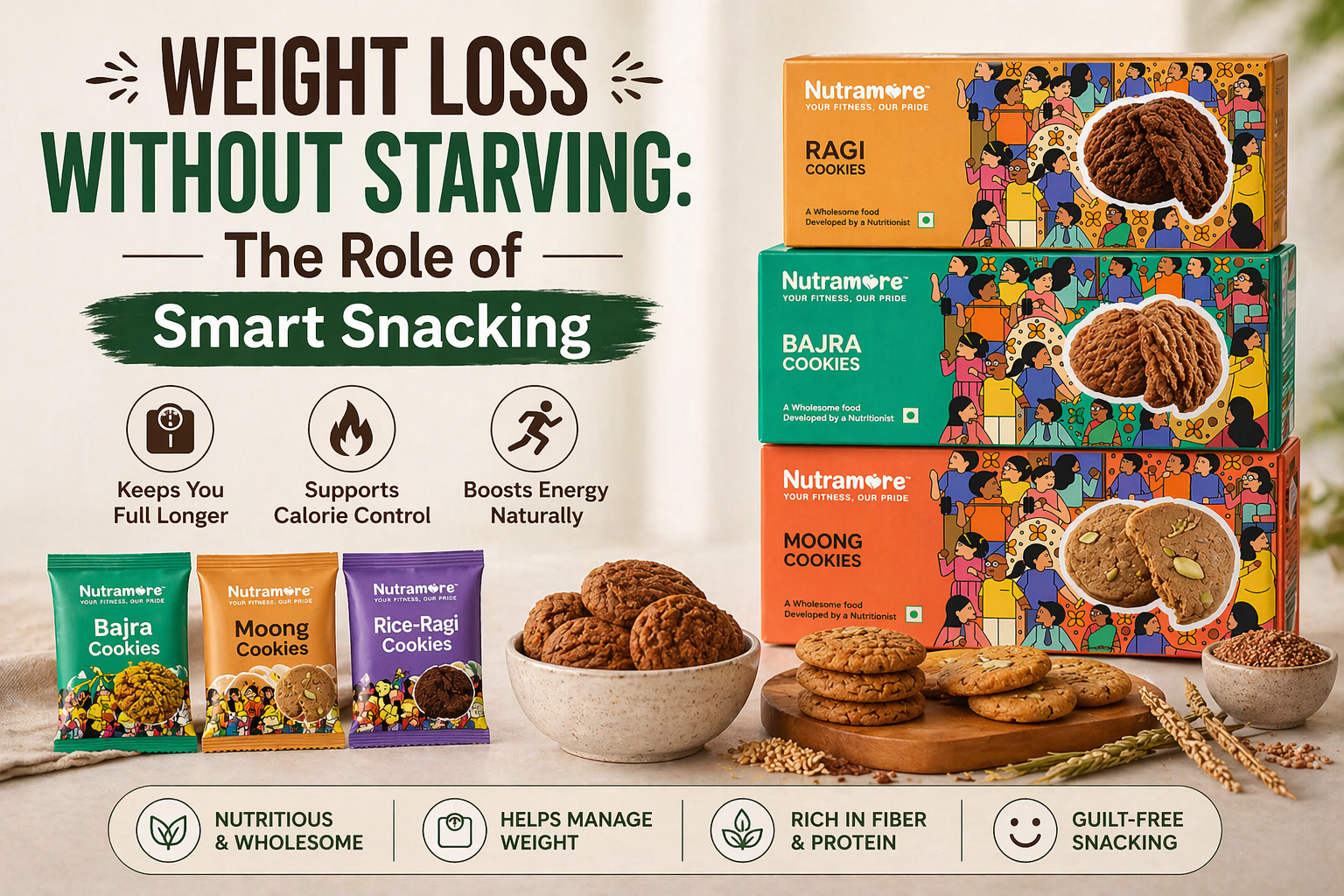
Take Nutramore's Bajra Cookies: the ingredient list begins with bajra flour — a whole grain, traceable, nutritionally intact. The sweetener is chemical-free jaggery. The fat is fresh butter. The list is short. Every ingredient is a food, not an additive. There are no artificial colours, no flavour enhancers, no partially hydrogenated fat, no refined sugar, and no maida — not as claimed badges on the front, but as the self-evident reality of the ingredient list on the back.
The same structure holds across the full range. Jowar Coconut Cookies are jowar, jaggery, butter, coconut — recognisable food, clean formulation, short list. Ragi Chocolate Cookies are ragi, jaggery, butter, cocoa — again, a list a consumer can verify against their own kitchen knowledge. Baked Protein Sticks are a dal blend, spices, cold-pressed oil — 18g of protein from ingredients, not from isolated protein compounds.
This is what label transparency looks like in practice: not a cascade of front-of-pack claims about what the product doesn't contain, but a short ingredient list that makes the quality of what it does contain immediately legible.
For families wanting to apply this standard across the full range, the Try & Taste Trial Pack provides nine different millet flavour mini packs — each with the same clean-label foundation — allowing families to identify preferences before building a full pantry. The Chocolate Cookies Combo covering Bajra-Moong, Jowar Chocolate, and Ragi Chocolate cookies, the Gluten-Free Cookies Combo, and the All-Time Favourite Cookies Combo all provide multi-flavour variety within the same clean-ingredient framework.
A Practical Checklist: Beyond "No Preservatives"
When evaluating any packaged snack — for yourself, for your children, for any family member — here is the full checklist that goes beyond preservative status to assess genuine ingredient quality:
Step 1 — Ignore the front of pack entirely. Turn the product over immediately and go to the ingredient list. Front-of-pack claims are marketing. The ingredient list is disclosure.
Step 2 — Check the first three ingredients. If refined wheat flour (maida), sugar, or a refined oil appears in the first three, the product's primary identity is defined by these ingredients regardless of what else it contains. If a whole grain, millet flour, or pulse flour appears first, continue evaluating.
Step 3 — Count the sugar names. Look for: sugar, glucose, dextrose, fructose, maltose, corn syrup, invert sugar, cane juice, caramel, maltodextrin, fruit juice concentrate. If three or more of these appear anywhere in the ingredient list, the product's total sugar content is substantially higher than any single one would indicate.
Step 4 — Check for vanaspati or partially hydrogenated fat. These words anywhere in the ingredient list mean trans fats are present regardless of what the nutrition panel shows (which may round to zero at sub-threshold levels).
Step 5 — Look for colour additive numbers. E102, E104, E110, E122, E124, E129, E133 in the ingredient list indicate artificial colours associated with hyperactivity concerns in children.
Step 6 — Look for flavour enhancers. E621 (MSG), E627, E631 indicate flavour enhancement designed to override natural satiety signals.
Step 7 — Check total sugar per serving — and check the serving size. Multiply the sugar per serving by the number of servings your child actually eats. Under 5g per realistic portion is acceptable. Over 10g is a flag regardless of any front-of-pack claim.
Step 8 — Check protein and fiber. Under 2g protein and under 1g fiber per serving means the snack contributes nothing to satiety and nothing to blood sugar stability — it is a pure caloric event, clean or otherwise.
A product that passes all eight steps is genuinely clean — not merely preservative-free. Most products in Indian supermarkets will fail at step two or three, regardless of the claims on the front.
Why This Matters More Than It Might Seem
The gap between "No Preservatives" and genuinely clean formulation is not a trivial semantic distinction. It is a gap through which significant nutritional harm accumulates.
A child who eats two servings of a "No Preservatives" maida-and-sugar biscuit twice a day, five days a week, across their primary school years, has consumed thousands of blood sugar spike events, thousands of ghrelin rebound episodes, significant quantities of refined sugar that progressively damages insulin sensitivity, and effectively zero dietary fiber from snacks across the most microbiome-formative years of their development — all while their parents made choices that felt informed because the packaging said the right things.
This is the real cost of label illiteracy — not individual bad decisions but the systematic accumulation of nutritional harm hidden behind technically accurate marketing language.
The solution is not to distrust all packaged food or to expect perfection from every snack. It is to develop the specific, practical skill of reading beyond the front-of-pack claims to the ingredient list and nutrition panel that actually describe what is in the product — and to apply the checklist above consistently enough that it becomes automatic.
"No Preservatives" is a starting point. It is not a destination. The destination is a short ingredient list of recognisable whole foods, appropriate sweeteners, real fats, and the protein and fiber that distinguish genuinely nourishing snacks from merely chemical-adjective-free ones.
Final Thoughts
"No Preservatives" means one thing: the product does not contain the specific additives classified as preservatives under FSSAI regulations. It means nothing about the presence of refined flour, refined sugar, trans fats, artificial colours, flavour enhancers, or excessive sodium — all of which can coexist with the claim and all of which have documented effects on health that dwarf the concerns most consumers associate with preservatives.
The front of a food pack is a marketing document designed to create a favourable impression using the minimum legally required factual basis. The back of the pack is the disclosure. Developing the habit of going directly to the back — to the ingredient list and the nutrition panel — and evaluating what is actually in the product against a clear standard is the single most powerful food literacy skill available to any consumer.
The standard is simple: recognisable whole-food ingredients, appropriate sweeteners, real fats, adequate protein and fiber, and a list short enough to be read and understood in thirty seconds. Products that meet this standard do not need a "No Preservatives" badge because the ingredient list makes the case on its own terms.
That is the standard worth holding your snacks to — and it is a standard that exists in the Indian food market today, for anyone who knows where to look.
Explore Nutramore's full range of clean-label, short-ingredient-list millet snacks at nutramore.in/our-products