You are standing in a supermarket aisle, packet in hand, squinting at a nutrition label printed in font so small it requires reading glasses you don't have with you. The front of the pack says "whole grain," "natural," "no added preservatives," and has a picture of a smiling child surrounded by fruit.
The back of the pack tells a different story — if you know how to read it.
Food labelling in India is regulated, but it is also deeply confusing by design. Manufacturers are required to list ingredients and nutritional information, but the way that information is presented, ordered, and described often obscures more than it reveals. Parents who want to make genuinely informed snacking choices for their children need a working knowledge of how to decode what they are actually looking at.
This guide gives you exactly that — a practical, step-by-step framework for reading food labels on children's snacks, identifying what matters, spotting the red flags buried in the fine print, and making choices that actually align with your child's health rather than a brand's marketing budget.
Why Food Labels on Children's Snacks Are Especially Misleading
Before we get into the mechanics of label reading, it helps to understand why this skill matters so much specifically for children's snacks.
Children's food is one of the most heavily marketed categories in the packaged food industry. The packaging is deliberately designed to trigger a child's desire (bright colours, cartoon characters, bold fonts) while simultaneously reassuring the parent (health claims, nutrition badges, ingredient highlights). The goal is to make both the child and the parent feel good about the purchase — regardless of what the product actually contains.
The front of the pack is pure marketing. In India, FSSAI regulations allow manufacturers to make health claims under certain conditions, but the front of a pack has no mandatory format and can include virtually any claim the brand chooses, as long as it doesn't make an outright false disease claim. "Baked not fried," "contains calcium," "made with real fruit," "whole grain goodness" — these claims are technically true in the most literal sense while being deeply misleading about the overall nutritional quality of the product.
The back of the pack — the nutrition facts panel and the ingredient list — is where the truth lives. And the truth, once you know how to read it, is often very different from the front.
The Five Things You Must Check on Every Label
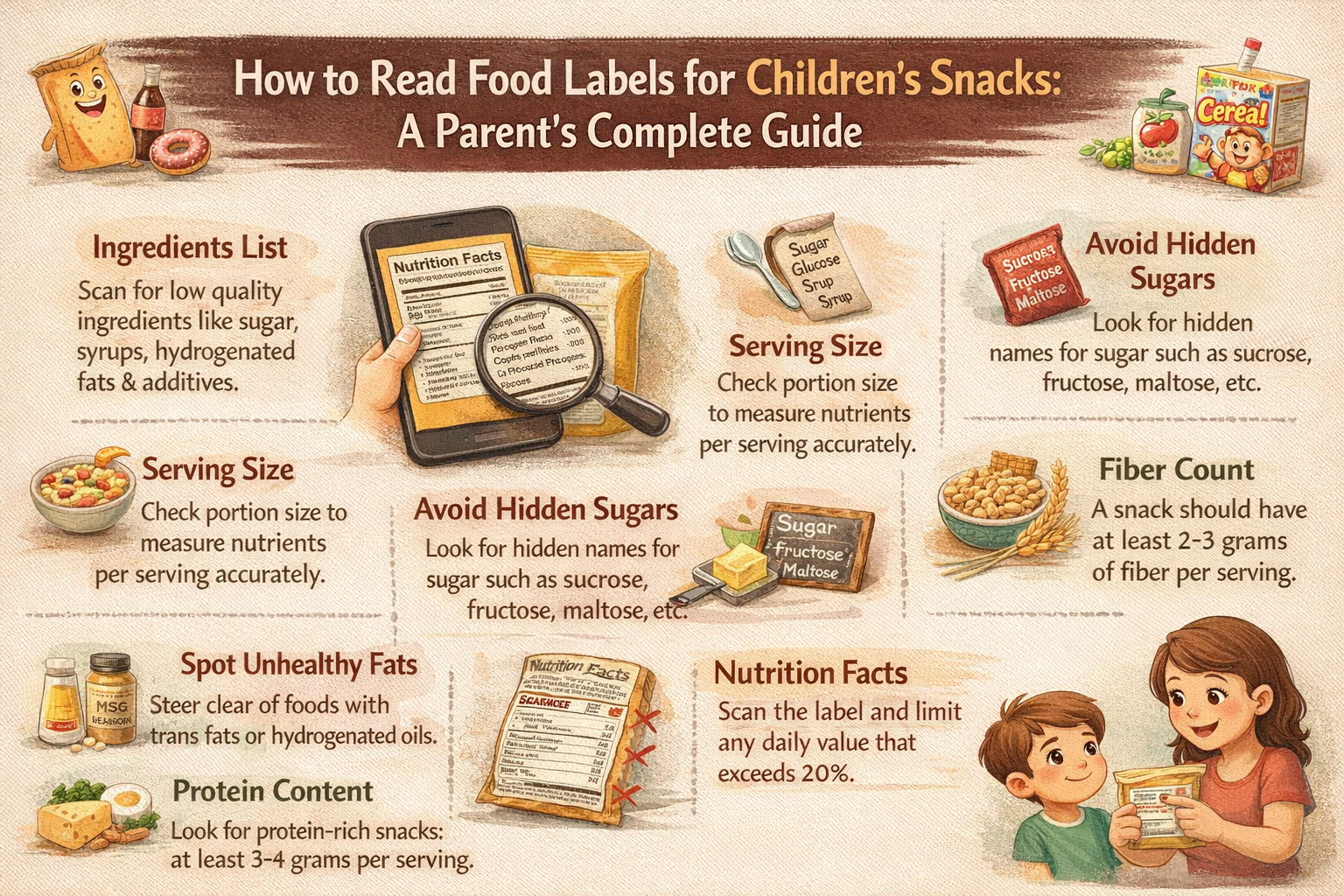
1. The Ingredient List — Read It First, Not Last
The ingredient list is the single most important part of any food label, and most parents read it last, if at all. This is backwards.
The ingredient list is governed by one simple rule: ingredients are listed in descending order by weight. Whatever appears first is present in the largest quantity. Whatever appears last is present in the smallest.
For children's snacks, what you want to see first is a recognisable whole food — whole grain flour, millet flour, oats, dal, nuts. What you do not want to see first — or even in the top three ingredients — is refined wheat flour (maida), sugar, or a refined oil.
Specific things to look for in the first three ingredients:
A snack that lists "refined wheat flour (maida)" as its first ingredient is primarily a maida product, regardless of what the front claims. A snack that lists "sugar" as its second ingredient contains more sugar by weight than almost anything else in it. A snack that lists a whole grain or millet first and has a pulse or nut in the top five is nutritionally structured in the right direction.
The sugar name game: Sugar does not always appear on an ingredient list as "sugar." Manufacturers routinely use multiple forms of sugar under different names to prevent any single sugar from appearing high on the list — because if all sugars were combined, they might rank first or second. Names to recognise and count as sugar: glucose, fructose, dextrose, maltose, corn syrup, high-fructose corn syrup, invert sugar, cane juice, caramel, maltodextrin (partial), fruit juice concentrate, and sucrose. If you see three or four of these in a single ingredient list, the product's total sugar content is far higher than any one of them individually suggests.
Red flag ingredients to look for by name: Partially hydrogenated oils or vanaspati (trans fats), sodium benzoate and potassium sorbate (preservatives), tartrazine and sunset yellow (artificial colours linked to hyperactivity in children), monosodium glutamate or flavour enhancers (631, 627), and TBHQ (a synthetic antioxidant used in fried snacks).
2. Total Sugar — The Number That Matters Most
On the nutrition facts panel, find the row labelled "Total Sugars" or "Carbohydrates of which sugars." This is the combined total of all sugars in the product, regardless of how many different names they appear under in the ingredient list.
What is an appropriate sugar limit for children's snacks?
The World Health Organization recommends that free sugars make up less than 10% of total daily energy intake for children — ideally less than 5%. For a child consuming approximately 1,400–1,600 calories per day, this translates to roughly 35–40g of total sugar per day across all meals and snacks.
A single serving of many popular Indian children's biscuits contains 8–12g of sugar. If a child eats two or three servings across the day — which is entirely typical — that one category of snack alone accounts for most or all of their recommended daily sugar budget, leaving no room for naturally occurring sugars in fruit, milk, and meals.
Practical benchmarks for a single children's snack serving:
Under 5g of total sugars — excellent. 5–8g — acceptable if the rest of the nutritional profile is strong. 8–12g — high; inspect the ingredient list carefully. Over 12g per serving — avoid for regular use.
The "per serving" trick: Always check the serving size printed on the label before reading any numbers. Manufacturers routinely set serving sizes unrealistically small — sometimes as low as 20g for a biscuit — knowing that children will eat 2–3 times that amount. Mentally multiply every number on the label by the number of servings your child actually eats.
3. The Fat Quality Check — Not All Fats Are Equal
The nutrition panel lists total fat, saturated fat, and sometimes trans fat. These numbers matter, but what matters more is the type of fat — and that information is only in the ingredient list, not the panel.
Fats to welcome in children's snacks: Butter (real, fresh butter — not vanaspati), cold-pressed groundnut oil, cold-pressed coconut oil, and naturally occurring fats in nuts and seeds. These are stable, appropriately saturated or monounsaturated, and support brain development, hormone production, and fat-soluble vitamin absorption in children.
Fats to avoid: Partially hydrogenated vegetable oil or vanaspati — these contain trans fats that are harmful to children's cardiovascular and neurological development. Refined palm oil and refined soybean oil in large quantities — these are high in omega-6 fatty acids that promote inflammation. Many manufacturers now claim "0g trans fat" while still listing partially hydrogenated oil in their ingredients — this is technically legal because Indian labelling allows rounding to zero below a certain threshold, but the product still contains trans fats.
The test: If the ingredient list includes "vanaspati," "partially hydrogenated," or "hydrogenated vegetable fat" in any position, put the product down. This applies even if the nutrition panel says 0g trans fat.
4. Protein Content — The Most Overlooked Number
Parents consistently focus on sugar and fat when reading labels, but protein is equally important — particularly for children's snacks. Protein determines how long a snack keeps a child full, how stable their blood sugar remains after eating, and whether the snack supports growth and muscle development or simply provides energy.
What to look for: A genuinely nutritious children's snack should contain at least 2–3g of protein per serving. Snacks with 4–6g or more per serving are excellent. Pure carbohydrate snacks — most biscuits, puffs, and crackers — typically contain less than 1–2g of protein, providing no blood sugar stabilisation and poor satiety.
The source of protein matters as much as the quantity. Protein from whole pulses, millets, and nuts is accompanied by fiber and micronutrients. Protein from isolated whey or soy protein concentrate — added to some "healthy" children's snacks — is a processed addition that doesn't carry the same nutritional co-benefits.
Nutramore's Baked Protein Sticks deliver 18g of protein per 75g pack — from a whole dal blend, not isolated protein. The Green-Gram Upma Premix provides 32g of protein per serving. These are the kinds of numbers that make a real difference to a child's satiety, blood sugar stability, and nutritional adequacy across the day.
5. The Fiber Check — The Number Most Labels Bury
Dietary fiber is listed on Indian nutrition labels, but it is easy to overlook because it appears near the bottom of the panel and because most packaged children's snacks contain so little of it that the number seems negligible.
Why fiber matters for children: Fiber slows digestion, preventing blood sugar spikes. It feeds beneficial gut bacteria that regulate mood, immunity, and appetite. It supports healthy bowel function. And it is directly linked to reduced risk of obesity, type 2 diabetes, and metabolic syndrome — even in children.
What to look for: A children's snack with 2g or more of dietary fiber per serving is doing something useful. A snack with under 0.5g of fiber — the typical figure for refined flour biscuits — is providing essentially no digestive benefit and likely spiking blood sugar rapidly.
Whole millet-based snacks naturally contain 3–8g of fiber per 100g, depending on the grain. This is the structural advantage of choosing whole grain and millet-based options over refined grain snacks — the fiber is intrinsic to the ingredient, not added as a supplement.
Decoding Health Claims on the Front of Pack
The front of a children's snack pack is a marketing document. Here is a translation guide for the most common claims you will encounter:
"Made with whole grains" — check the ingredient list. If whole grain flour appears third on the list after maida and sugar, the product contains whole grains — but primarily it is a maida-and-sugar product. The claim is technically true and practically misleading.
"No added preservatives" — this typically means no sodium benzoate or potassium sorbate. It does not mean the product is free of artificial colours, flavour enhancers, or trans fats. It does not make it healthy.
"Baked not fried" — baking instead of frying is genuinely better, as it reduces oxidised oil content. However, a baked maida-and-sugar biscuit is still a maida-and-sugar biscuit. This claim addresses one concern while leaving all others intact.
"Contains calcium / iron / vitamins" — almost any food can make this claim if it contains trace amounts of fortified ingredients. The question is not whether the product contains calcium — it is how much, in what form, and in what food matrix. 30mg of calcium in a refined flour biscuit is not remotely comparable to the naturally occurring 344mg per 100g in ragi.
"Natural flavours" — in Indian food labelling, "natural flavour" is a broadly defined category that can include highly processed flavour extracts. It does not mean the flavour comes from a whole fruit, spice, or food ingredient.
"Sugar free" — this means no added sucrose, but the product may contain glucose, fructose, maltitol, sorbitol, or other sweeteners that still affect blood sugar or cause digestive distress in children. Always check what sweetener is actually being used.
"No maida" — this is a genuinely useful claim when verifiable in the ingredient list. Verify it. If the first ingredient is "wheat flour" without the qualifier "whole wheat," that is still refined flour in most cases.
A Quick Label-Reading Routine for the Supermarket
Given that most parents are in a hurry when shopping, here is a 60-second label-reading routine that covers the essentials:
Step 1 (10 seconds) — flip to the back. Ignore the front entirely.
Step 2 (15 seconds) — read the first three ingredients. If you see maida, refined wheat flour, or sugar in the top three, put it back. If you see a whole grain, millet, or pulse first, continue.
Step 3 (10 seconds) — check total sugars per serving. Under 5g is good. Over 10g is a red flag. Remember to check the serving size.
Step 4 (10 seconds) — check protein. Under 2g per serving means the snack will not provide satiety. Over 4g is genuinely useful.
Step 5 (10 seconds) — scan for trans fats. Search for "vanaspati," "hydrogenated," or "partially hydrogenated" anywhere in the ingredient list. If present, reject.
Step 6 (5 seconds) — count sugar names. If you can see three or more different sugar names (glucose, dextrose, maltose, cane juice, corn syrup, fructose), the total sugar content is almost certainly much higher than the label suggests.
This routine can be done in under a minute once it becomes habit, and it will screen out the majority of nutritionally poor children's snacks before they reach your cart.
What a Clean Children's Snack Label Actually Looks Like
To make this concrete — here is what Nutramore's label approach reflects, and why it matters in the context of everything covered above.
The ingredient list on Nutramore's Bajra Cookies starts with bajra (pearl millet flour) — a whole grain. The sweetener is chemical-free jaggery — not refined sugar, not glucose syrup, not a combination of six sugar names. The fat source is fresh butter — not vanaspati, not partially hydrogenated oil. There are no artificial colours, no synthetic flavour enhancers, no preservatives.
The same structure applies across the full millet cookie range — whether you are looking at Ragi Chocolate Cookies, Jowar Coconut Cookies, Rice Ragi Cookies, or Moong Almond Pistachio Cookies. The base is always a whole millet or pulse. The sweetener is always jaggery. The fat is always real butter. The list is short. Every ingredient is recognisable.
This is what a clean label looks like in practice: short, readable, with ingredients you could theoretically find in a kitchen rather than a chemical catalogue.
For children who need variety, the Chocolate Cookies Combo — combining Bajra-Moong, Jowar Chocolate, and Ragi cookies — gives three different millet bases and flavour profiles, all meeting the same clean-label standard. And for families just beginning this transition, the Try & Taste Trial Pack with 9 mini flavours lets children find their favourites before you commit to a full pack.
Teaching Children to Read Labels Too
One of the most lasting things a parent can do is involve children in label reading from an early age — not as a lesson in restriction, but as a skill in understanding what food actually is.
Children as young as 6–7 can be taught to look for the first ingredient on a label and ask the question: "What is this mostly made of?" By 10–12, most children can understand the concept of sugar names and can spot the pattern of multiple sugar aliases. Teenagers who have grown up with this skill make markedly different snacking choices independently — not because they have been told what not to eat, but because they understand what they are looking at.
Frame it as detective work, not food policing. "Let's see what's really in this one" is a very different message from "that's bad for you." One builds curiosity and capability. The other builds anxiety and rebellion.
Final Thoughts
Food labels are not designed to help you make the best decision for your child. They are designed to make you feel confident about a purchase that may or may not deserve that confidence. The gap between those two things is where most of the confusion — and most of the poor snacking choices — lives.
But with a working knowledge of ingredient list order, sugar name aliases, fat type identification, and protein and fiber benchmarks, you have everything you need to cut through the marketing and see a product for what it actually is.
The standard to hold children's snacks to is simple: whole grain or millet base, real sweetener, real fat, adequate protein, meaningful fiber, no artificial additives. That standard exists. Products meeting it exist. The skill is knowing how to find them — and how to recognise the ones that only pretend to.
Explore Nutramore's full range of clean-label millet snacks at nutramore.in/our-products