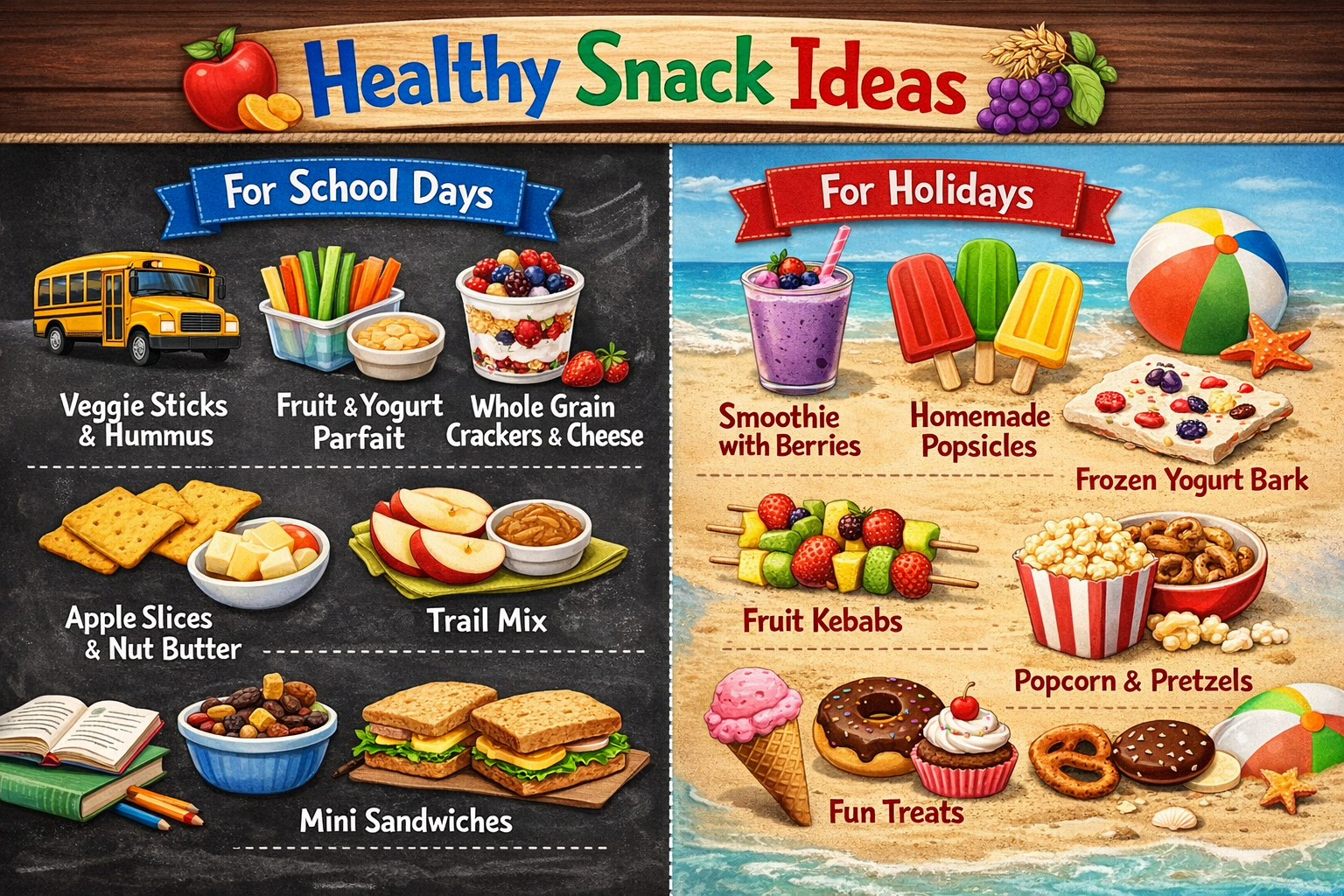
Ask any parent what the hardest part of feeding children well is, and the answer is almost never "I don't know what's healthy." It is: "I run out of ideas." And the second answer is almost always: "What works on a school day doesn't work on a holiday, and vice versa."
This is a genuinely different problem for each context. School days are about speed, portability, and reliability — a snack that can be packed in two minutes, survives a schoolbag, doesn't require refrigeration, and will actually be eaten by a child who is distracted, hungry, and surrounded by friends with different snacks. Holidays are about involvement, variety, and the luxury of time — children at home, more appetite, more boredom, more opportunity to cook together and explore food in ways that aren't possible on a rushed weekday morning.
Both contexts matter. Both require planning. And both offer more nutritional opportunity than most families realise — once you have a clear map of what to do when.
This blog gives you that map.
Why the School Day vs Holiday Distinction Matters
Before jumping into ideas, it's worth understanding why these two contexts genuinely require different approaches — and why trying to use the same snacking strategy for both usually fails.
On school days, the constraints are real and non-negotiable. You have limited time in the morning. The snack must be packed and sealed before 7am in most Indian households. It cannot require heating. It must be leak-proof. It must be something the child will eat even when tired or distracted. It must provide genuine nutrition — particularly the protein and complex carbohydrate combination that supports attention, memory consolidation, and energy through the afternoon school hours. And it must not be so messy or smelly that it becomes a social event in the classroom.
On holidays, the entire dynamic shifts. Children are at home, which means snacking frequency increases — boredom eating is real, and the kitchen is constantly accessible. But so is opportunity. You have time to prepare things together. You can offer warmer, more elaborate options. You can involve the child in deciding what to eat, which consistently improves willingness to try new things. And you can use snack time as a moment of connection rather than a logistical transaction.
The nutritional priorities also shift slightly. School day snacks need to be primarily focused on sustained energy and cognitive support — steady glucose to the brain, protein to prevent the mid-afternoon crash that many children experience between 2 and 4pm. Holiday snacks can be more varied, more exploratory, and occasionally more indulgent — within a framework of real ingredients.
Part One: School Day Snacks
What a Good School Day Snack Must Do
A school day snack serves two nutritional purposes. The morning snack — typically eaten during a mid-morning break around 10–11am — bridges the gap between breakfast and lunch, preventing the blood sugar dip that impairs attention and increases irritability in classroom settings. Research consistently shows that children who eat a mid-morning protein-and-fiber snack perform measurably better on cognitive tasks in the late morning period than those who don't.
The afternoon snack — if the child comes home before dinner — needs to prevent the post-school crash and carry them through homework, activity, and the pre-dinner wait without resorting to ultra-processed fillers that suppress appetite for the family meal.
Both snacks need to work within tight logistical constraints. Here is what that looks like in practice.
School Day Snack Category 1: The Lunchbox Snack (Mid-Morning Break)
This is the snack that goes into the school bag before sunrise and gets eaten in a 10–15 minute break window, often while standing, sometimes while talking, occasionally while being inspected by curious classmates.
The requirements: Dry, sealed, no refrigeration, no utensils, no mess, genuinely appealing, genuinely nutritious.
What works:
Millet-based cookies are the single most practical solution for this slot. They travel well, they don't require preparation, they have a long shelf life without preservatives if made from real ingredients, and children consistently enjoy them. The key is choosing ones made from whole millet flour, sweetened with jaggery rather than refined sugar, and with enough protein and fiber to sustain energy through the rest of the morning rather than causing a spike and crash.
Nutramore's Jowar Chocolate Cookies and Bajra Moong Chocolate Cookies are particularly well-suited to the lunchbox because the chocolate flavour makes them genuinely exciting for children, while the jowar and bajra-moong base delivers sustained energy from complex carbohydrates and protein. No refined sugar. No maida. Jaggery sweetened. A child who opens their tiffin box and sees these doesn't feel like they've been given a "healthy" snack — they feel like they've been given a treat.
For children who prefer something less sweet and more substantial, Nutramore's Baked Protein Sticks are an excellent lunchbox companion. They are compact, mess-free, flavourful, and deliver 18g of protein per pack — a genuinely meaningful protein contribution that keeps a child full and focused through the rest of the school morning.
Other whole-food lunchbox snacks to rotate:
A small handful of mixed nuts (almonds, cashews, walnuts) in a sealed container — high in healthy fats and protein, requiring no preparation. A piece of seasonal fruit alongside a protein-containing item — the fruit alone spikes blood sugar, but paired with a protein snack, the glycemic response is moderated significantly. Roasted chana or makhana in a small sealed box — light, portable, and a reasonable protein source. Hard-boiled eggs for non-vegetarian families — one of the most complete portable proteins available.
School Day Snack Category 2: The After-School Refuel (4–6pm)
This is the highest-risk snacking window for most Indian children. They come home from school hungry, tired, and often emotionally depleted from a long day of concentration and social navigation. The combination of low blood sugar and low willpower — both the child's and the parent's — is exactly when the packaged chips and biscuit packets come out.
The after-school snack needs to do two things simultaneously: satisfy the immediate hunger and mood dip without torpedoing dinner appetite, and provide the protein and complex carbohydrate combination that supports homework focus in the early evening.
What works:
A warm, protein-rich snack is ideal for this window because warmth is satisfying and comforting after a long school day, and protein at this point genuinely supports the evening's cognitive demands.
Nutramore's Jowar Upma Premix and Jowar Chilla Mix both prepare in under 10 minutes and deliver 30g of complete protein — genuinely substantial for an after-school snack that supports energy without overfilling a child before dinner. The jowar chilla is particularly popular with children because of its pancake-like format and the way it can be served with a small amount of homemade chutney or curd.
Nutramore's Millet Methi Crispies work well if you need something ready instantly — no preparation, genuinely satisfying crunch, baked not fried, and with enough protein and fiber to take the edge off hunger without filling a child completely.
For days when the child needs something sweet — which after a difficult school day is both understandable and legitimate — Ragi Chocolate Cookies or Rice Ragi Cookies alongside a glass of warm milk provide a classic, balanced combination: the cookies deliver ragi's calcium and fiber, the milk adds protein, and the combined glycemic response is far more stable than refined biscuits alone.
A Sample School Day Snack Week
Rather than deciding snacks daily — which adds to the morning chaos — planning a week's snack rotation in advance removes the decision fatigue that leads to defaulting to poor choices.
Here is what a practical, nutritious school week snack rotation looks like — using a mix of prepared and ready-to-eat options:
Monday: Lunchbox — Jowar Chocolate Cookies. After school — Jowar Upma. Tuesday: Lunchbox — Baked Protein Sticks + small banana. After school — Millet Methi Crispies + curd. Wednesday: Lunchbox — Bajra Moong Chocolate Cookies. After school — Jowar Chilla with chutney. Thursday: Lunchbox — Mixed nuts + Rice Ragi Cookies. After school — Ragi Chocolate Cookies + warm milk. Friday: Lunchbox — Moong Almond Pistachio Cookies. After school — Green-Gram Upma.
This rotation provides variety across the week while maintaining consistent nutritional quality. All lunchbox items require zero morning preparation. All after-school items can be prepared in under 10 minutes or served immediately.
Part Two: Holiday Snacks
The Holiday Snacking Challenge
Holidays introduce a different set of problems. Children are home, active, bored, hungry more frequently, and have more access to the kitchen — and therefore more access to whatever is in it. Snack frequency typically increases from two structured occasions to three or four ad-hoc ones. This means total daily snack calories increase, and if the snack quality doesn't keep pace, the nutritional gap compounds quickly across a week of holidays.
But holidays also offer the greatest opportunity for nutritional gain. With time, you can prepare things that aren't possible on school days. You can cook with your child. You can explore new flavours and textures. You can use food as an activity rather than a transaction. And you can establish food preferences and memories that last well beyond the holiday — children who cook with parents consistently show greater food variety and less picky eating throughout childhood.
The holiday snacking strategy should lean into this opportunity.
Holiday Snack Category 1: The Activity Snack (Morning)
Holiday mornings often start later and stretch longer than school day mornings. Children are typically active — playing, running, creating — and their morning hunger arrives later but is often more intense than on school days.
The morning snack on a holiday can be more substantial and more interactive than a lunchbox item. It can involve the child in preparation. It can be warm and slightly elaborate. And it should be protein-forward enough to sustain energy through active play without causing a mid-morning crash.
What works:
A jowar or green-gram chilla made together — this is genuinely one of the best holiday morning snack activities available. Children who help mix the batter, pour it onto the tawa, and watch it cook are dramatically more likely to eat it enthusiastically and feel proud of the result. Nutramore's Jowar Chilla Mix and Green-Gram Upma Premix reduce the preparation complexity while maintaining the involvement factor — the child measures the mix, adds water, stirs, and watches the cooking process. The result is 30g of complete protein in a format they helped create.
A fruit and millet cookie plate — on holidays, snacks can look like an occasion rather than a quick refuel. A small plate with seasonal fruit, a couple of Moong Almond Pistachio Cookies or Multigrain Coffee Cookies, and a small bowl of nuts creates variety, visual appeal, and a genuinely balanced snack that a child feels is special without any of it being nutritionally poor.
Holiday Snack Category 2: The Boredom Snack (Mid-Day)
The mid-day holiday snack is the most dangerous. It typically happens not because the child is genuinely hungry, but because they are bored, between activities, looking for stimulation, and the kitchen is the easiest destination. This is the snacking window most likely to involve repeated trips to the pantry for refined crisps, biscuits, and anything else that is easy to grab.
The strategy here is twofold: make the healthy option the easiest option by keeping it visible and accessible, and occasionally convert snack time into a brief activity that provides the stimulation the child is actually seeking.
What works:
Keeping a visible bowl or basket of ready-to-eat healthy snacks — Millet Methi Crispies, Baked Protein Sticks, and a variety of millet cookies — means that when a child wanders into the kitchen looking for something, the default choice is nutritionally sound. Environmental design consistently outperforms willpower as a health strategy for children.
A simple "build your own" snack plate — offer the child a small plate and three or four options to choose from: a couple of millet cookies, some fresh fruit pieces, a small bowl of roasted chana, and perhaps a piece of cheese or a spoonful of peanut butter. Let them assemble their own plate. The element of choice and control dramatically reduces refusal and dramatically increases enjoyment. Children who feel they have agency over what they eat are consistently more adventurous and more satisfied.
For a slightly more involved option on a quiet afternoon, making laddoos together from ragi flour, jaggery, ghee, and crushed nuts is an excellent holiday kitchen activity — the result is nutritious, the process is engaging, and the child gets to eat something they made from scratch.
Holiday Snack Category 3: The Social Snack (When Friends Visit or Family Gathers)
Holiday social occasions create one of the most consistent pressures toward poor snacking choices. When cousins visit, when neighbours drop in, when families gather — the default is to put out chips, biscuits, and packaged snacks because they feel casual, easy, and crowd-pleasing.
The good news is that millet-based snacks presented well are genuinely crowd-pleasing — children are not rejecting these foods because they taste bad, they are unfamiliar with them because they haven't been offered. A well-presented plate of varied millet cookies alongside a savoury option is indistinguishable from a packaged snack spread in terms of the enjoyment it generates, and dramatically different in terms of what it delivers nutritionally.
What works:
A snack spread using the Chocolate Cookies Combo — combining Bajra-Moong Chocolate, Jowar Chocolate, and Ragi Chocolate cookies — presented on a plate creates variety, visual appeal, and a chocolate-forward selection that children at a social gathering will find genuinely appealing. Paired with Millet Methi Crispies and Baked Protein Sticks for the savoury option, you have a complete social snack spread that no child — or adult — will feel is a compromise.
The All-Time Favourite Cookies Combo — Jowar, Rice-Ragi, and Bajra — works particularly well for mixed-age gatherings because the flavour variety means different children gravitate toward different preferences. Some will love the Jowar Coconut. Others will prefer the Bajra. A spread with options removes the "I don't like that one" dynamic and ensures more children find something they enjoy.
Holiday Snack Category 4: The Evening Wind-Down Snack
Holiday evenings often extend later than school day evenings, and children's hunger cycles accordingly. The 6–7pm window on a holiday is a genuine snacking occasion that doesn't exist as prominently on school days when dinner is earlier and the appetite is more structured.
This snack needs to be light enough not to suppress dinner appetite, but substantial enough to prevent the grumpiness and irritability that comes from genuinely low blood sugar in a tired child.
What works:
Warm milk with a couple of Ragi Chocolate Cookies — ragi's exceptional calcium content makes this combination a meaningful contribution to daily calcium intake, and the warm milk provides tryptophan that supports the transition toward sleep. This is one of the oldest snacking traditions in Indian homes for good nutritional reason.
A small bowl of Jowar Upma or a half-portion of Green-Gram Upma — warm, savoury, protein-containing, and light enough not to constitute a second dinner.
Rice Ragi Cookies with a piece of seasonal fruit — the cookies provide sustained energy and calcium, the fruit provides natural sweetness and hydration, and the combination is light enough not to affect dinner appetite while being substantial enough to genuinely satisfy.
Building a Snack Pantry That Works for Both
The single most useful structural change most families can make is to stock a snack pantry that works across both contexts — school days and holidays — without requiring separate planning for each.
The core items that span both contexts are: a rotation of millet-based cookies in multiple flavours (so variety exists without daily decision-making), at least one savoury option that works for both lunchboxes and home snacking, one or two breakfast premix options for quick warm snacks, and a supply of whole nuts and seasonal fruit as supporting items.
Nutramore's Gluten-Free Cookies Combo — combining Multigrain Coffee, Bajra-Moong Chocolate, and Rice-Ragi cookies — is a particularly versatile pantry staple because the three flavours cover different taste preferences (coffee, chocolate, plain) and all three travel equally well in lunchboxes and work equally well for home snacking.
The Savoury Snacks Combo — pairing Millet Methi Crispies with Baked Protein Sticks — covers the savoury snacking need for both school days (lunchbox or after-school) and holidays (mid-day boredom snack, social spread, or evening wind-down), without requiring separate savoury purchases.
For families new to millet-based snacking, the Try & Taste Trial Pack with 9 flavour mini packs is the best starting point — it lets each child in the family identify their preferences before you build the full pantry around what they genuinely enjoy.
One Rule That Works in Both Contexts
Across all the variation between school days and holidays, there is one principle that applies without exception: the snack you plan for is the snack that happens. The snack you don't plan for is the one that gets replaced by whatever is easiest — and in most Indian homes, what's easiest is still refined, packaged, and nutritionally poor.
Planning a week's snacks takes 10 minutes on a Sunday. Stocking a pantry with items that work across both contexts means that Monday morning chaos and Wednesday holiday boredom both have the same reliable, nutritious answer.
The goal is not perfection. It is default. When the easy option and the healthy option are the same thing — because you've made them the same thing through planning and stocking — consistency follows naturally.
Final Thoughts
School days and holidays are not nutritional opposites — they are different expressions of the same underlying goal: giving children food that genuinely supports their energy, attention, growth, and enjoyment of eating.
School days demand convenience, reliability, and portability. Holidays offer time, involvement, and variety. Both are opportunities — and both are more manageable than they feel in the middle of a busy term or a restless holiday week, once you have a clear framework and a well-stocked pantry to support it.
Millet-based snacks — whether it's a lunchbox cookie, an after-school chilla, a holiday snack plate, or a social gathering spread — work in both contexts because they are genuinely delicious, genuinely nutritious, and genuinely convenient in ways that refined snacks are not.
That combination is not a compromise. It is the standard worth building your child's snacking life around.
Explore Nutramore's full range at nutramore.in/our-products