The word "diet" carries a specific meaning in popular culture that is nutritionally distinct from its scientific definition. When most people say they are "going on a diet," they mean a temporary, calorically restricted eating protocol designed to produce rapid weight loss — followed, typically, by a return to previous eating patterns once the target weight is reached or the restriction becomes unsustainable.
The research on this approach is remarkably consistent. Approximately 80–95% of people who lose weight through caloric restriction regain it within 1–5 years. The regained weight is often greater than the amount lost. And each successive dieting cycle is associated with greater metabolic adaptation — lower resting metabolic rate, greater insulin resistance, and stronger compensatory hunger responses — making subsequent weight loss attempts increasingly difficult.
This is not a failure of individual willpower. It is the predictable outcome of fighting the body's evolutionary survival programming rather than working with it.
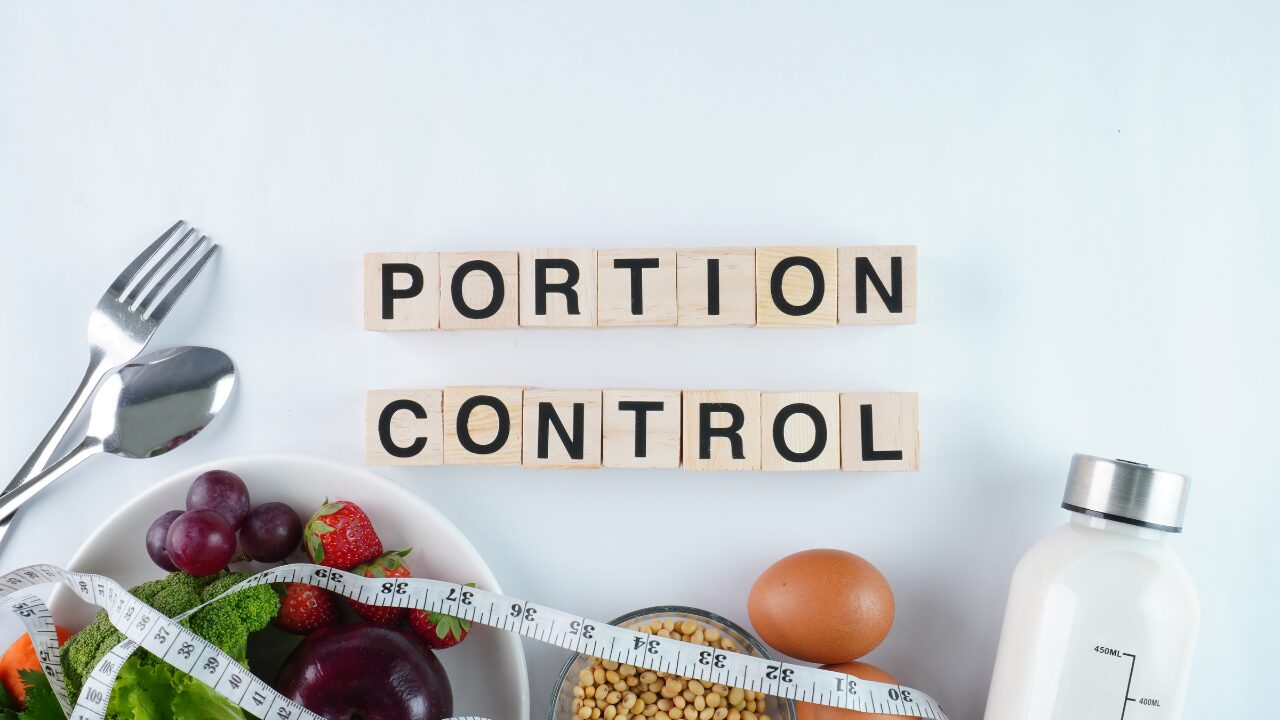
Portion control — done correctly, which means through food quality rather than food quantity restriction — is the approach that consistently outperforms dieting in long-term weight maintenance, precisely because it works with the body's hunger regulation mechanisms rather than against them.
Why Dieting Fails: The Biological Mechanisms
The failure of caloric restriction diets is not primarily psychological — it is physiological. The body responds to significant caloric restriction through a cascade of adaptations specifically designed to restore the previous energy state:
Adaptive thermogenesis reduces BMR by 15–25% — as covered in the meal-skipping blog. The body reduces its energy expenditure to match the reduced input, progressively closing the caloric deficit that the diet was supposed to maintain.
Ghrelin rises persistently — hunger hormone levels increase during caloric restriction and remain elevated above pre-diet levels even after restriction ends, producing persistent hunger that drives caloric restoration.
Leptin falls — the satiety hormone produced by adipose tissue falls in proportion to fat mass reduction, reducing the satiety signal and further driving hunger.
Muscle is catabolised for gluconeogenesis — reducing the lean muscle mass that determines resting metabolic rate, leaving the post-diet person lighter but metabolically slower.
The brain's reward response to food intensifies — neuroimaging research has documented increased activation of reward circuits in response to food cues after caloric restriction, making food more compelling and harder to resist.
All five of these adaptations work against weight maintenance — and all five are activated most powerfully by the severe caloric restriction of aggressive dieting. They are not activated significantly by the modest caloric reduction associated with improved food quality in adequate portions.
What Portion Control Actually Means (And Does Not Mean)
The popular understanding of portion control — smaller plates, measuring cups, weighing food — misses the most important insight from the science of satiety: the most effective way to eat less is to choose foods that make eating less feel natural rather than effortful.
This is not wordplay. The satiety hormone response to a meal — the GLP-1 and PYY stimulation that signals the hypothalamus to stop eating — is profoundly influenced by the composition of the food, not just its quantity. A 300-calorie meal that triggers a strong satiety hormone response will produce comfortable fullness and sustained appetite suppression at the next meal. A 300-calorie meal that triggers a weak satiety hormone response (because it contains little protein or fiber) will produce brief satisfaction followed by ghrelin rebound, leading to a subsequent meal that is larger than it would have been with the more satiating option.
Effective portion control is therefore primarily about food selection — choosing foods that produce stronger satiety signals per calorie — rather than food restriction. It is the difference between eating less through effort (forcing smaller portions of unsatisfying food) and eating less through design (choosing foods that naturally produce fullness at appropriate portions).
The Satiety Hierarchy: Which Foods Make Portion Control Effortless
The Satiety Index — developed by nutritional researcher Dr. Susanne Holt — ranks foods by their capacity to produce satiety per calorie. The findings are consistent and instructive:
High-protein foods produce the greatest satiety per calorie — protein's GLP-1 and PYY stimulation and ghrelin suppression produce sustained fullness that carbohydrate and fat cannot match. High-fiber foods produce the next greatest satiety — the physical bulk and the GLP-1 stimulation from fiber reaching the lower gut sustain fullness beyond the meal itself. Low-GI foods produce more sustained satiety than high-GI equivalents of the same caloric content — because they prevent the ghrelin-stimulating blood glucose crash that high-GI foods produce.
Conversely, refined carbohydrate foods — despite their palatability — rank among the lowest on the satiety index. Croissants, biscuits, white bread, and similar products score the worst of all measured foods — providing less satiety per calorie than almost any other category.
The practical implication is direct: replacing high-GI, low-protein, low-fiber snacks with low-GI, protein-and-fiber-rich alternatives produces spontaneous reduction in overall caloric intake — not through restriction, but through the natural operation of satiety hormones that the better food activates more powerfully.
The Research on Protein-Driven Portion Control
The most robust evidence for food-composition-mediated portion control comes from protein studies. When protein intake is increased from approximately 15% of calories to 25–30% of calories — without any instruction to restrict calories — subjects consistently spontaneously reduce caloric intake by 400–500 calories per day. This reduction is entirely involuntary — it is the direct consequence of the enhanced ghrelin suppression and GLP-1 stimulation from higher protein intake, not of any deliberate effort to eat less.
Research by Dr. David Weigle at the University of Washington demonstrated that increasing protein from 15% to 30% of calories produced spontaneous caloric reduction and weight loss over 12 weeks — without any caloric restriction instruction and without any reduction in food satisfaction. The participants were not dieting. They were eating more protein, feeling more satisfied, and naturally eating less as a consequence.
This is the mechanism of effective portion control: protein drives satiety, satiety reduces appetite, reduced appetite produces smaller portions naturally — at no cost to satisfaction.
The Fiber Dimension: Volumetric Eating Without Caloric Penalty
Dietary fiber adds bulk and physical volume to food without caloric contribution — creating gastric distension (physical fullness from stomach stretching) alongside the hormonal satiety effects described above. High-fiber foods therefore produce fullness at lower caloric loads than equivalent-calorie low-fiber foods — a volumetric advantage that supports portion appropriateness without restriction.
A bowl of whole grain jowar upma with vegetables provides significantly more physical volume and fiber bulk than a bowl of semolina upma of equivalent calories — the physical presence of the whole grain fiber and vegetable bulk produces greater gastric distension and longer-lasting fullness, naturally reducing the quantity that feels satisfying.
The Green-Gram Upma Premix combines high fiber from green gram and grain base with 32g of protein — producing the strongest satiety signal available from a practical breakfast or snack format. The result in practice is that a single serving comfortably carries most people through 3–4 hours without meaningful hunger — not through caloric restriction, but through satiety hormone activation that makes that quantity of food genuinely sufficient.
Practical Portion Control Principles
Eat protein first at every meal and snack. The sequence in which foods are consumed within a meal influences satiety hormone activation. Beginning with protein — dal, paneer, eggs, curd, or a protein-rich snack — activates GLP-1 and PYY before the carbohydrate arrives, moderating the glucose response and establishing a satiety baseline that makes stopping at an appropriate portion more natural.
Use hunger, not time, as the primary eating cue. Many people eat at fixed times regardless of physiological hunger — which means eating when not hungry (because it is "lunchtime") and therefore eating more than the body requires. Eating in response to genuine physical hunger — stomach emptiness, mild energy reduction, reduced concentration — and stopping at genuine satiety — physical comfort without fullness, absence of hunger rather than presence of excess — produces natural portion appropriateness without measuring anything.
Make the healthy option the easy option through pantry design. The most effective portion control tool available is environmental — keeping foods that produce strong satiety signals readily available and visible, and reducing the accessibility of foods that produce weak satiety signals and appetite stimulation. If the snack drawer contains Baked Protein Sticks and Millet Methi Crispies rather than refined biscuits, the default snacking choice becomes one that supports rather than undermines portion control — without any active decision required.
Build protein into every snack occasion. Protein at snack time suppresses ghrelin for 2–3 hours, directly reducing appetite at the subsequent meal. A mid-morning snack with 10–15g of protein consistently produces smaller, more appropriate lunch portions than a mid-morning snack with no protein — even when the snack calories are equivalent.
Allow 20 minutes for satiety signals to register before second helpings. The hormonal satiety response — GLP-1 and PYY signalling to the hypothalamus — takes approximately 15–20 minutes to reach full magnitude. Eating quickly outpaces this signal, producing consumption beyond actual satiety before the body's fullness indication arrives. Eating slowly — a genuine 20-minute minimum for a proper meal — allows satiety signals to catch up with consumption, naturally preventing overeating without portion measuring.
The Snack-Meal-Snack Rhythm and Portion Naturalisation
One of the most effective structural supports for natural portion control is the snack-meal-snack rhythm described across multiple blogs in this series: a protein-and-fiber-rich morning snack at 10am, a moderate well-composed lunch at 1pm, a protein-and-fiber-rich afternoon snack at 4pm, and a moderate dinner at 7–8pm.
This rhythm prevents the extreme hunger that drives large, fast, poorly-composed meals. It maintains blood glucose stability that prevents the cortisol and ghrelin surges that produce appetite amplification. And it distributes protein intake across the day in a way that maintains consistent GLP-1 and PYY stimulation — keeping the appetite regulation system in the mode where stopping at an appropriate portion is biologically natural rather than effortful.
The All-Time Favourite Cookies Combo for sweet snacking, the Savoury Snacks Combo for savoury snacking, and the Breakfast Premix Combo for high-protein morning and heavy snack occasions provide the full-week snacking infrastructure that supports this rhythm without daily planning decisions.
Final Thoughts
Dieting fails because it asks the biology to comply with arithmetic — creating a caloric deficit through restriction that the body's survival mechanisms are specifically designed to close. Portion control succeeds because it asks the biology to function as designed — eating foods that activate the satiety mechanisms that evolution developed to prevent overconsumption, and letting those mechanisms produce appropriate portions naturally.
The effort required is not restriction — it is selection. Choosing protein-and-fiber-rich foods over low-protein, low-fiber ones. Choosing low-GI over high-GI. Choosing whole grain and pulse over refined and processed. These choices, made consistently at snacking occasions and meals, create the hormonal environment in which eating the right amount is the effortless default rather than a constant act of will.
This is portion control as a biological strategy rather than a behavioural one. And as a biological strategy, it produces results that last — because it is not fighting the body, but working with it.
Explore Nutramore's satiety-supporting millet range at nutramore.in/our-products