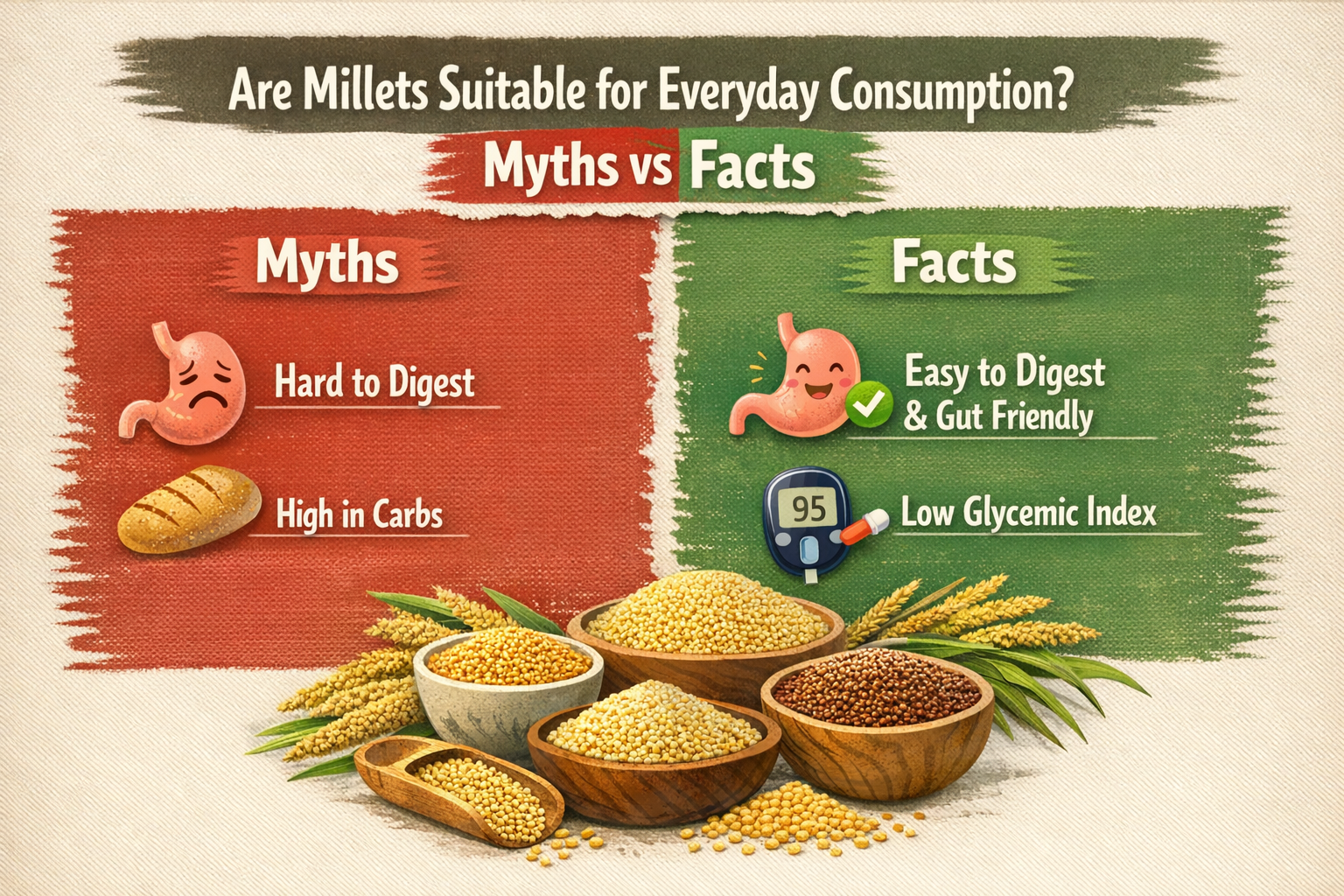
Millets are having a well-deserved comeback in Indian households. From government campaigns to celebrity nutritionists, everyone seems to be talking about jowar, bajra, ragi, and their extraordinary health benefits.
But alongside this revival, a wave of confusion has also emerged.
"Aren't millets cooling? Can I eat them in summer?" "I heard millets affect the thyroid — is that true?" "My doctor said not to eat too many millets." "Millets are only for people trying to lose weight, not for everyday use."
If you have heard any of these and found yourself unsure what to believe, you are not alone. Millets, despite being one of India's oldest and most nourishing staple grains, are surrounded by more myths than almost any other food today.
This blog is here to set the record straight — clearly, factually, and practically.
Why the Confusion Exists in the First Place
When a food transitions from being considered "traditional and rustic" to being labelled "superfood," two things happen simultaneously. Genuine scientific interest grows. And so does misinformation.
Some myths about millets come from misinterpreted Ayurvedic principles. Some come from outdated studies on isolated millet compounds. Some come from people extrapolating extreme scenarios — like feeding nothing but raw millet to animals — into everyday human dietary advice.
The result is that many people either over-restrict millets out of unnecessary fear or under-consume them because they are not sure how much is "safe."
The truth is far more straightforward. Let's go through the most common myths one by one.
Myth 1: "Millets Are Too Cooling for Daily Use — Especially in Winter"
The Fact: This is one of the most widely circulated myths, rooted in a partial understanding of Ayurvedic food properties.
Yes, Ayurveda classifies certain millets — particularly jowar and some varieties of foxtail millet — as having a slightly cooling effect on the body. But "cooling" in the Ayurvedic sense does not mean your body temperature drops or that eating jowar in December will give you a cold.
In Ayurvedic science, cooling refers to how a food influences the body's internal heat or pitta dosha — which is more about inflammation, acidity, and metabolic heat than ambient body temperature.
More importantly, bajra (pearl millet) is classified as warming — and has traditionally been consumed heavily in Rajasthan and Gujarat through harsh winters precisely because it provides sustained warmth and energy. Ragi sits in a neutral to mildly warming category.
In practice, traditional Indian diets varied millet consumption by season — more bajra in winter, more jowar in summer — not as a strict medical rule but as a natural dietary rhythm. Eating jowar in winter does not harm you. It just means you might want to balance it with warming spices like ginger or pepper, which is what Indian cooking naturally does anyway.
For everyday snacking year-round, Nutramore's Jowar Chocolate Cookies and Jowar Coconut Cookies are consumed comfortably across all seasons by thousands of customers — including in Pune's cold winters.
Myth 2: "Millets Suppress Thyroid Function — Avoid if You Have Hypothyroidism"
The Fact: This is perhaps the most persistent and anxiety-inducing myth around millets, and it deserves a careful, nuanced response.
Millets do contain goitrogens — compounds that, in theory, can interfere with iodine absorption and thyroid hormone production. The same compounds are found in broccoli, cauliflower, cabbage, soy, and mustard — foods most people with thyroid conditions eat regularly without concern.
Here is what the research actually shows:
Goitrogens in millets are primarily problematic only in two specific situations. First, when consumed in very large quantities — we are talking about millets making up the near-total caloric intake, which is not a realistic scenario in a balanced diet. Second, when combined with significant iodine deficiency in the diet. In a person consuming adequate iodine (through iodised salt, which virtually all Indian households use), the goitrogenic effect of moderate millet consumption is negligible.
Multiple studies, including those conducted in Indian populations, show that moderate millet consumption does not meaningfully affect thyroid hormone levels in people with normal or managed thyroid function.
Additionally, cooking deactivates a significant portion of goitrogens. Baked millet products, pressure-cooked millet meals, and fermented millet preparations all have substantially reduced goitrogenic activity compared to raw millet.
The practical guidance from most nutritionists today: people with hypothyroidism can include millets in their daily diet in normal portions. The key is variety — rotate between jowar, bajra, ragi, and other grains rather than eating only one millet in very large amounts every single day. This is simply good dietary practice regardless of thyroid health.
If you have specific thyroid concerns, always consult your doctor or dietician. But there is no scientific basis for a blanket "avoid millets" rule for thyroid patients eating a balanced diet.
Myth 3: "Millets Are Only for Weight Loss — Healthy People Don't Need Them"
The Fact: This myth treats millets as a therapeutic food for a specific condition rather than what they truly are — a nutritionally superior everyday grain suitable for everyone.
Millets are recommended for weight management because their high fiber content and low glycemic index promote satiety and regulate blood sugar. But these same properties benefit everyone — not just those trying to lose weight.
For children, millets — especially ragi — provide calcium critical for bone development. Ragi contains approximately 344mg of calcium per 100g, far exceeding most other plant foods. Nutramore's Sugar-Free Toddler Combo with Ragi, Moong, and Rice cookies is specifically designed for growing children who need this nutrient density daily.
For athletes and active individuals, the complete protein profile formed by millet–pulse combinations supports muscle repair and recovery. Nutramore's Baked Protein Sticks — a dal blend snack with 18g of protein — is a strong everyday protein source for anyone active.
For pregnant and breastfeeding women, bajra's iron content and ragi's calcium are precisely the nutrients most needed during this phase. The Multigrain Cookies Combo for Moms addresses these nutritional needs conveniently.
For seniors, easily digestible millets like ragi and rice millet support gut health while providing calcium and magnesium for bone density — both increasingly critical with age.
In short, millets are not medicine for a specific condition. They are excellent food for everyday life across every age group and health status.
Myth 4: "Millets Don't Taste Good — You Have to Force Yourself to Eat Them"
The Fact: This myth is more of an outdated cultural perception than a nutritional claim, but it keeps many people from ever exploring millets — so it is worth addressing directly.
The association of millets with bland, dry, or rough-textured food comes from memories of poorly prepared millet dishes or from comparing millets unfavourably to the refined, artificially flavoured snacks that dominate the packaged food market. Refined flour biscuits taste addictively sweet and light because they are designed to — using refined sugar, artificial flavours, and palm oil engineered for palatability.
When millets are prepared well — roasted, baked, paired with the right spices or natural sweeteners — they have a rich, nutty, earthy depth of flavour that refined wheat simply cannot replicate.
Nutramore's Multigrain Coffee Cookies combine millet's nuttiness with the boldness of coffee — a combination that consistently surprises first-time buyers. The Moong Almond Pistachio Cookies offer a richness that rivals any premium bakery cookie.
The Try & Taste Trial Pack — with 9 different flavours — exists precisely for this reason: to let people discover which millet flavour profile they love, before committing to a larger purchase. Most people find two or three favourites within the first pack.
Myth 5: "You Cannot Eat Millets Every Day — It Becomes Too Much"
The Fact: There is no established upper limit for healthy daily millet consumption in a balanced diet. The idea that millets need to be "cycled" or limited to a few days per week has no strong scientific foundation for healthy individuals.
What nutrition experts do recommend — and this applies to all grains, not just millets — is variety. Eating only jowar every single day is less ideal than rotating between jowar, bajra, ragi, and other millets across the week. This ensures you get the distinct nutrient profiles of each grain rather than over-relying on any single one.
In practice, having a millet-based breakfast four to five days a week, millet snacks daily, and millet-based dinners a few times a week is entirely appropriate and beneficial for most healthy adults. Many traditional Indian households — particularly in Maharashtra, Rajasthan, Karnataka, and Andhra Pradesh — consumed millets as their primary grain daily for generations, with no adverse effects. In fact, these populations historically showed lower rates of lifestyle diseases compared to urban wheat-dominant diets.
For a sustainable daily millet routine, starting with breakfast is the easiest entry point. Nutramore's Jowar Upma Premix, Green-Gram Upma Premix, and Jowar Chilla Mix are all ready in minutes and make millet consumption effortless on busy mornings. The Breakfast Premix Combo gives you all three together.
Myth 6: "Millets Are Hard to Digest"
The Fact: The opposite is true for most people. Millets are considerably easier on the digestive system than refined wheat flour.
This myth likely originates from two sources. One is the experience of people consuming millets in very large, unaccustomed quantities too quickly — any high-fiber food can cause temporary bloating if introduced suddenly to a gut accustomed to low-fiber processed foods. The second is the confusion between the tough outer husk of whole unprocessed millet (which is removed before cooking) and the grain itself.
The digestible part of millets — what you actually eat — is rich in both soluble and insoluble fiber that actively supports gut health. Jowar contains resistant starch that feeds beneficial gut bacteria. Ragi's polyphenols reduce gut inflammation. Rice millet is known specifically for its easy digestibility and is often recommended for infants and recovering patients.
Nutramore's Rice Cookies use rice millet for precisely this reason — high biological value protein and easy digestibility, making them suitable for all ages including young children and older adults.
If you are new to millets, the practical advice is simply to introduce them gradually — replacing one meal or one snack at a time rather than switching everything overnight. Within two to three weeks, most people's digestive systems adapt fully and many report significantly better digestion than they experienced with wheat-dominant diets.
Myth 7: "Millets Are Expensive and Hard to Find"
The Fact: Millets are among the most affordable grains available in India. Raw jowar, bajra, and ragi cost a fraction of the price of wheat flour in most markets, and substantially less than the packaged "health foods" most urban consumers spend on.
The perception of millets being expensive comes from the premium pricing of some trendy millet-based products in organic stores or health food chains. But the grain itself has always been economical — it is why millets historically fed large rural populations across India.
Today, with brands like Nutramore making millet-based products accessible online and competitively priced, incorporating millets into daily life has never been more straightforward. A pack of Bajra Cookies starting at ₹165, or a Breakfast Premix starting at ₹150, represents genuine everyday value — not a luxury purchase.
So, Are Millets Suitable for Everyday Consumption?
Based on everything above, the answer is a clear and confident: yes.
Millets are not a supplement, a remedy, or a dietary intervention. They are food — deeply rooted in Indian agricultural tradition, nutritionally superior to refined grains, and entirely appropriate as a daily staple for the vast majority of people across all age groups and health conditions.
The caveats are sensible and minimal: rotate between different millets for variety, cook them properly rather than consuming large amounts raw, maintain adequate iodine intake through iodised salt, and if you have specific medical conditions, check with your healthcare provider about portion guidance.
Beyond those basics, the path forward is simply to eat more millets — in your breakfast, in your snacks, in your meals — and experience the difference that real, traditional, nourishing food makes in your body over time.
Your Everyday Millet Starter Kit
If you are ready to make millets a genuine daily habit, here is a simple starting framework:
Morning — Jowar Upma Premix or Jowar Chilla Mix for a protein-rich, quick breakfast.
Mid-morning or evening snack — Any of Nutramore's millet cookies. Not sure where to start? The Try & Taste Trial Pack with 9 flavours is the easiest way to find your favourite.
Savoury snack — Millet Methi Crispies or Baked Protein Sticks when you want something crunchy and savoury without the guilt of fried food.
For families with children — Sugar-Free Toddler Combo for little ones and Moms Combo for expecting or nursing mothers.
Small, consistent changes. Real, lasting nutrition.
Explore the full range of everyday millet products at nutramore.in/our-products