Walk through any modern Indian supermarket and the fortification claims are everywhere. "Iron-fortified atta." "Vitamin D added milk." "B12-enriched breakfast cereal." "Omega-3 fortified biscuits." "Calcium-added bread." Products that have been nutritionally stripped by industrial processing, then had synthetic versions of specific nutrients added back in — and marketed as a result as nutritionally superior choices.
The marketing logic is appealing: if a food has added iron, calcium, or vitamin D, it must be better for you than one that doesn't. More nutrients, better food. Simple arithmetic.
The actual nutritional science is considerably more complex — and considerably less flattering to the fortification industry than the front-of-pack badges suggest.
Fortification is not without merit. In specific contexts, for specific populations, with specific nutrients, food fortification has produced genuine public health benefits. But as a general nutritional strategy — as the basis for choosing processed foods over whole foods — it fails in ways that the marketing comprehensively obscures.
This blog explains the science behind food fortification honestly: what it does well, what it cannot do, why whole foods consistently outperform fortified processed foods in virtually every dimension that matters to long-term health, and what this means practically for the food choices that determine nutritional outcomes for you and your family.
What Food Fortification Is — and Why It Exists
Food fortification is the deliberate addition of micronutrients — vitamins and minerals — to food during processing, either to replace nutrients lost during that processing or to address specific nutritional deficiencies in a target population.
It operates in two distinct forms with importantly different rationales.
Restoration fortification adds back nutrients that were present in the original whole food but removed during processing. The most common example in India is the addition of B vitamins and iron to refined wheat flour (maida) — nutrients that were abundantly present in the wheat grain's bran and germ, removed entirely when the grain was milled to produce white flour, and then partially added back as synthetic additives. The implicit acknowledgement here is striking: the processing was nutritionally destructive, and fortification is an attempt to partially compensate for that destruction.
Addition fortification adds nutrients that were never present in the original food in significant quantities. Vitamin D added to milk, omega-3 fatty acids added to biscuits, calcium added to orange juice. The rationale here is typically population-level deficiency — if a nutrient is broadly deficient in a population, adding it to a widely consumed food vehicle is a way to increase population-level intake without requiring individual behaviour change.
Both forms of fortification have legitimate public health applications. India's fortification programmes — including mandatory fortification of rice and wheat flour distributed through the Public Distribution System, and voluntary fortification of edible oils with vitamins A and D — have contributed to measurable reductions in specific micronutrient deficiencies in target populations.
The problem arises not with the public health application of fortification, but with its commercial application — the use of fortification claims to market processed foods of otherwise poor nutritional quality as health products, and the implicit messaging that fortified processed foods can substitute for whole foods in a well-designed diet.
What Fortification Cannot Replace
To understand the limitations of fortification, it helps to understand the full complexity of what whole foods actually provide — because the gap between what whole foods deliver and what fortification adds back is far larger than the nutrient count on a label suggests.
The Food Matrix Problem
Nutrients in whole foods do not exist in isolation. They exist within a complex structural environment — the food matrix — that includes thousands of compounds interacting with each other in ways that profoundly affect how nutrients are absorbed, transported, metabolised, and utilised.
In a whole grain like ragi or jowar, iron exists in the context of naturally occurring vitamin C precursors, organic acids, and amino acids that enhance its absorption. In fortified refined wheat flour, iron is added as ferrous sulphate or elemental iron — synthetic forms that, without the accompanying compounds present in the original grain, are absorbed at a fraction of the efficiency.
This difference in absorption efficiency is not marginal. Research comparing iron absorption from whole foods versus iron-fortified refined foods consistently shows that the bioavailability — the proportion of iron that actually enters the bloodstream and becomes available for cellular use — of intrinsic iron in whole foods is 2–5 times higher than that of the synthetic iron added to fortified products.
The same principle applies to virtually every fortified nutrient. Calcium in ragi exists alongside phosphorus, magnesium, and vitamin K2 in proportions that support optimal calcium utilisation for bone mineralisation. Calcium added to fortified orange juice or bread exists without these cofactors — absorbed and utilised less efficiently and in a metabolic context that may not direct it preferentially to bone.
Vitamin E in whole nuts and seeds exists as a mixture of tocopherols and tocotrienols — eight distinct forms with different biological activities. Vitamin E added to fortified cereals is typically alpha-tocopherol alone — one of the eight forms, added in a ratio that does not reflect what whole foods provide and that in high doses may actually interfere with the activity of the other tocopherol forms.
The food matrix is not a background context for nutrient delivery. It is an active participant in nutrient absorption and utilisation. And it cannot be replicated by adding isolated synthetic nutrients back to a food from which it was removed.
Phytonutrients — The 99% That Fortification Ignores
The human understanding of nutrition is comprehensively incomplete. The nutrients that have been identified, named, measured, and added to food represent a small fraction of the biologically active compounds present in whole foods.
Millets alone contain hundreds of identified phytonutrients — polyphenols, flavonoids, phenolic acids, tannins, phytates, carotenoids — each with documented biological activities including antioxidant protection, anti-inflammatory signalling, enzyme inhibition, and gut microbiome modulation. Jowar's polyphenols inhibit the starch-digesting enzymes that drive glycemic spikes. Ragi's catechins and epicatechins inhibit adipogenesis and support insulin sensitivity. Bajra's lignans modulate hormone metabolism. Moong's flavonoids support cardiovascular health through multiple mechanisms simultaneously.
None of these compounds are nutrients in the conventional sense — they are not classified as vitamins or minerals, they do not appear on nutrition panels, and they are not added during fortification. They exist in whole foods as the product of millions of years of plant evolution — complex chemical ecosystems that have co-evolved with human biology and that provide biological benefits that no synthetic fortification programme has the knowledge or capacity to replicate.
When a whole grain is refined, these phytonutrients are lost along with the bran and germ that contain them. When iron and B vitamins are added back, the phytonutrients are not. The fortified refined flour is nutritionally richer than the unfortified version in the specific nutrients that were added — and nutritionally poorer in every other dimension compared to the original whole grain.
This is the fundamental asymmetry that fortification marketing obscures: it counts what was added back and ignores the vastly larger number of beneficial compounds that remain absent.
Synergistic Nutrient Interactions
Whole foods deliver nutrients in synergistic combinations that consistently produce effects greater than the sum of their individual parts — a phenomenon that nutritional science has documented extensively but that fortification, which adds nutrients individually or in limited combinations, cannot replicate.
The vitamin C-iron synergy in whole foods is a well-established example. But the interactions go far deeper. In whole millets, magnesium and B vitamins work together as cofactors in the energy metabolism pathways that determine how efficiently cells generate ATP. In whole pulses, zinc and protein work together — the amino acids providing the transport proteins that carry zinc through the intestinal wall, and zinc providing the enzymatic activity that supports protein synthesis.
These interactions are not additive. They are multiplicative — the nutritional effect of magnesium and B vitamins together in the food matrix is not the sum of magnesium's effect and B vitamins' effect measured separately. It is a combined effect that emerges from their interaction and that disappears when they are separated.
Fortification adds nutrients back one or a few at a time, without the broader nutritional context that produces these synergistic interactions. The result is a product that is richer in specific measured nutrients but poorer in the integrated nutritional ecosystem that makes those nutrients fully effective.
Where Fortification Has Genuine Value
Having laid out the limitations of fortification as a substitute for whole food nutrition, it is important to be accurate about where fortification does serve a genuine and important function — because the answer is not "nowhere."
Addressing single-nutrient deficiencies at population scale. When a specific nutrient is broadly deficient in a population — particularly when that deficiency has severe health consequences and when dietary change is slow to implement — fortification of a widely consumed food vehicle is a legitimate and effective public health intervention.
Iodine fortification of salt is the most successful example in nutritional public health history. Iodine deficiency disorders — including goitre and cretinism — were widespread in many parts of India before salt iodisation programmes were implemented. Universal salt iodisation has reduced iodine deficiency dramatically and represents fortification at its most effective: a single nutrient, a single vehicle consumed by virtually the entire population, a specific deficiency with severe consequences.
Folic acid fortification of flour in countries where neural tube defects were prevalent has similarly demonstrated measurable reduction in birth defect rates. India's consideration of mandatory folic acid fortification is grounded in genuine epidemiological evidence.
Supporting specific vulnerable populations. Pregnant women with iron deficiency, exclusively breastfed infants whose mothers have vitamin D deficiency, elderly individuals with impaired B12 absorption — these are populations where fortified foods or supplements address genuine deficiency risks that dietary improvement alone may not fully resolve in time.
Supplementing but not replacing whole food diets. Fortification has its greatest value when it addresses a specific gap in an otherwise nutritionally sound diet — not when it is used as a nutritional foundation that substitutes for whole food quality.
The distinction is between fortification as a safety net — catching specific deficiencies that a generally good diet still misses — and fortification as a marketing tool — using added nutrients to make nutritionally poor products appear to be health foods.
The Bioavailability Gap: Why Added Nutrients Are Not Equivalent to Natural Ones
The comparison above points to a concept that deserves its own dedicated explanation: bioavailability — the proportion of an ingested nutrient that is actually absorbed into the bloodstream and made available for cellular use.
Bioavailability is not a fixed property of a nutrient. It is a property of a nutrient in a specific food context — determined by the form in which the nutrient is present, the other compounds present in the food that enhance or inhibit absorption, the health of the gut microbiome, and the individual's baseline nutritional status.
Whole foods, through millions of years of co-evolution with human digestive biology, typically present nutrients in forms and contexts that maximise bioavailability. Fortification programmes, constrained by cost, technology, and the challenge of adding nutrients to foods that don't naturally contain them, typically use cheaper synthetic forms that are less bioavailable than the intrinsic forms in whole foods.
Iron — the most commonly fortified nutrient in Indian food — illustrates this gap starkly. Iron in food exists in two forms: haem iron (found in animal products) and non-haem iron (found in plant foods). Non-haem iron from whole plant foods like bajra and moong is absorbed at approximately 15–20% efficiency in the presence of enhancing factors like vitamin C and organic acids. Elemental iron — the most commonly used form in flour fortification due to its low cost and stability — is absorbed at approximately 1–5% efficiency. Ferrous sulphate, another common fortification form, performs better (15–20% absorption) but is less stable and more likely to cause taste problems in the food vehicle. The choice of iron form in fortification programmes is a genuine determinant of whether the fortification produces meaningful biological effect.
Calcium — added to many dairy alternatives, breads, and fortified snacks — similarly shows bioavailability variation depending on form. Calcium from ragi (in the food matrix, with cofactors) is absorbed at approximately 20–30% efficiency. Calcium carbonate — the most common fortification form — is absorbed at 17–22% efficiency under optimal conditions (with food, with adequate stomach acid). In elderly individuals with reduced stomach acid, or individuals taking proton pump inhibitors, calcium carbonate absorption drops dramatically. Calcium citrate performs better across pH ranges but is more expensive and less commonly used in food fortification. Ragi requires no such consideration — its calcium is delivered in the food matrix that digestive biology evolved to handle.
Vitamin D — added to milk, cereals, and some fortified foods in India — is a case where fortification can provide genuine value, because vitamin D from food is not the primary natural source (sunlight is). However, vitamin D2 (ergocalciferol), the plant-derived form typically used in food fortification, is approximately 30–50% less effective at raising and sustaining serum vitamin D levels than vitamin D3 (cholecalciferol) produced by skin in sunlight or available from animal sources. Many fortified foods use D2 for cost and supply chain reasons — a meaningful difference in effectiveness that the "Vitamin D added" claim does not distinguish.
Omega-3 fatty acids — added to an increasing range of "healthy" fortified snacks including some biscuits — are perhaps the most problematic fortification category. The omega-3s of greatest biological significance are EPA and DHA — the long-chain forms found in fatty fish and algae. Most omega-3 fortification uses ALA (alpha-linolenic acid) from flaxseed or similar plant sources, because it is cheaper and more stable. The human body converts ALA to EPA and DHA — but at an efficiency of only 5–10%. Omega-3 biscuits, therefore, deliver primarily ALA — a form that requires conversion the body performs poorly — rather than the EPA and DHA whose biological benefits have been most extensively studied.
The Indian Nutritional Deficiency Picture: What Fortification Addresses vs What It Doesn't
India faces genuine and serious micronutrient deficiency challenges that provide context for understanding where fortification policy is directed and where whole food strategies remain the more sustainable solution.
Iron deficiency anaemia affects approximately 53% of women of reproductive age and 67% of children under five in India — among the highest rates in the world. Fortification of staple foods is a rational public health response to a deficiency this widespread. But it is worth noting that the Indian diet contains iron-rich foods — bajra, ragi, moong, green leafy vegetables — whose routine consumption would address iron deficiency without requiring industrial fortification. The deficiency is driven primarily by the displacement of these traditional iron-rich foods by refined wheat, polished rice, and processed snacks that contain minimal iron — either natural or fortified.
Vitamin B12 deficiency is particularly prevalent among vegetarian populations — approximately 47% of the Indian population shows B12 deficiency or insufficiency in some studies. B12 is found naturally only in animal products; vegetarians and vegans have genuine difficulty meeting B12 requirements through diet. This is a category where fortification or supplementation has legitimate value precisely because the deficiency is not addressable through whole plant food consumption alone.
Vitamin D deficiency affects 70–90% of Indians across all economic strata — a staggering prevalence that reflects both reduced outdoor sunlight exposure and limited dietary vitamin D sources. Again, this is a category where fortification supplements a gap that diet alone, even a maximally whole-food diet, cannot fully close.
Iodine deficiency — successfully addressed by salt iodisation — represents fortification's public health success story, as discussed earlier.
The pattern is instructive: fortification has clearest justification for nutrients that are genuinely difficult to obtain from whole food diets — B12 for vegetarians, vitamin D for people with limited sunlight exposure, iodine in iodine-poor soil regions. It has weaker justification for nutrients like iron and B vitamins that are abundantly present in the whole grains and pulses that industrial food processing has displaced — and whose deficiency is primarily a consequence of that displacement rather than an inherent limitation of vegetarian whole food diets.
What the Research Says: Whole Food Diets vs Fortified Food Diets
The question of whether people eating whole food diets show better nutritional outcomes than those relying on fortified processed foods has been examined in nutritional epidemiology, and the results consistently favour whole foods.
A landmark series of analyses examining the relationship between dietary patterns and chronic disease risk — including the PREDIMED study, the EPIC cohort, and numerous Indian dietary studies — consistently finds that the strongest protective effects against cardiovascular disease, type 2 diabetes, obesity, and several cancers are associated with dietary patterns characterised by whole food consumption — not with specific nutrient intakes, whether from whole foods or fortified products.
This is the "wholeness effect" — the observation that the health benefits associated with consuming nutrient-rich foods cannot be fully accounted for by the specific nutrients those foods contain. When researchers have attempted to reproduce the health benefits of whole food consumption by providing the same nutrients in supplement or fortified food form, the results have been consistently disappointing — and in some cases, counterproductive.
The beta-carotene supplementation trials of the 1990s are the most famous cautionary example. Observational studies had consistently shown that people with high blood levels of beta-carotene — a marker of high vegetable and fruit consumption — had lower rates of lung cancer. The hypothesis that beta-carotene itself was protective led to large randomised controlled trials of beta-carotene supplements in high-risk populations. The results were alarming: supplemented populations in two major trials showed significantly increased lung cancer rates and overall mortality. The protective effect was associated with whole food consumption, not with the isolated nutrient.
This finding has been replicated with varying degrees of significance across multiple nutrients: vitamin E supplements have failed to reproduce the cardiovascular protective effects of vitamin E-rich food patterns. Calcium supplements have shown associations with cardiovascular events that calcium-rich food consumption does not. Folate supplements have shown associations with colorectal cancer risk that have not been observed with dietary folate from whole foods.
The pattern is consistent enough to have generated a theoretical framework: whole food nutrients are absorbed, distributed, and metabolised differently from isolated synthetic nutrients, in ways that produce different biological effects — and the whole food context produces the effects that are associated with health protection, while the isolated nutrient form frequently does not.
The Commercial Fortification Problem in India: Specific Concerns
Beyond the general science, the specific commercial application of fortification in the Indian market has several documented concerns that consumers should be aware of.
Using fortification to justify a premium on nutritionally poor products. "Iron-fortified" biscuits, "vitamin-enriched" breakfast cereals, and "omega-3 added" children's snacks routinely carry significant price premiums over their unfortified equivalents — while the underlying product remains refined flour, refined sugar, and refined oil. The nutritional value added by the fortification is modest; the marketing value added is substantial.
Fortification as a distraction from ingredient quality. When a product's front-of-pack communication is dominated by fortification claims, it draws attention away from the ingredient list. Parents reading "Contains Iron, Calcium, and Vitamin D" on a children's biscuit are less likely to notice "refined wheat flour, sugar, partially hydrogenated vegetable fat" on the ingredient list. The fortification claim functions as a nutritional credential that legitimises a product whose overall quality does not warrant consumer confidence.
Overclaiming absorption equivalence. Fortification marketing routinely implies or states that the added nutrient is nutritionally equivalent to the same nutrient in whole food form — without disclosing the bioavailability differences described above. "Contains as much iron as 100g of spinach" on a biscuit label may be technically accurate for the amount of iron added, while being deeply misleading about the amount of iron a consumer's body will actually absorb and use from each source.
Fortification of inherently inappropriate food vehicles. Omega-3 fatty acids oxidise easily when exposed to heat, light, or air — adding them to baked biscuits with a long shelf life at room temperature significantly compromises the quality and quantity of the omega-3 that reaches the consumer, even if the amount added at manufacture was meaningful.
The Whole Food Advantage: What Cannot Be Added Back
Returning to the positive case for whole foods — because this blog is ultimately about choosing better, not simply criticising fortification — it is worth being specific about what whole millets and pulses provide that no fortification programme delivers.
The complete phytonutrient ecosystem. Jowar's polyphenols — tannins, anthocyanins, phenolic acids — inhibit the starch digestion enzymes that drive glycemic spikes, reduce LDL oxidation, and modulate inflammatory pathways. These compounds are not nutrients in the conventional sense, appear on no nutrition panel, and are added back in no fortification programme. They are present in whole jowar and absent in refined wheat regardless of what is added to it. Nutramore's Jowar Upma Premix and Jowar Chilla Mix deliver these polyphenols intact, in a food matrix where they are bioactive rather than degraded.
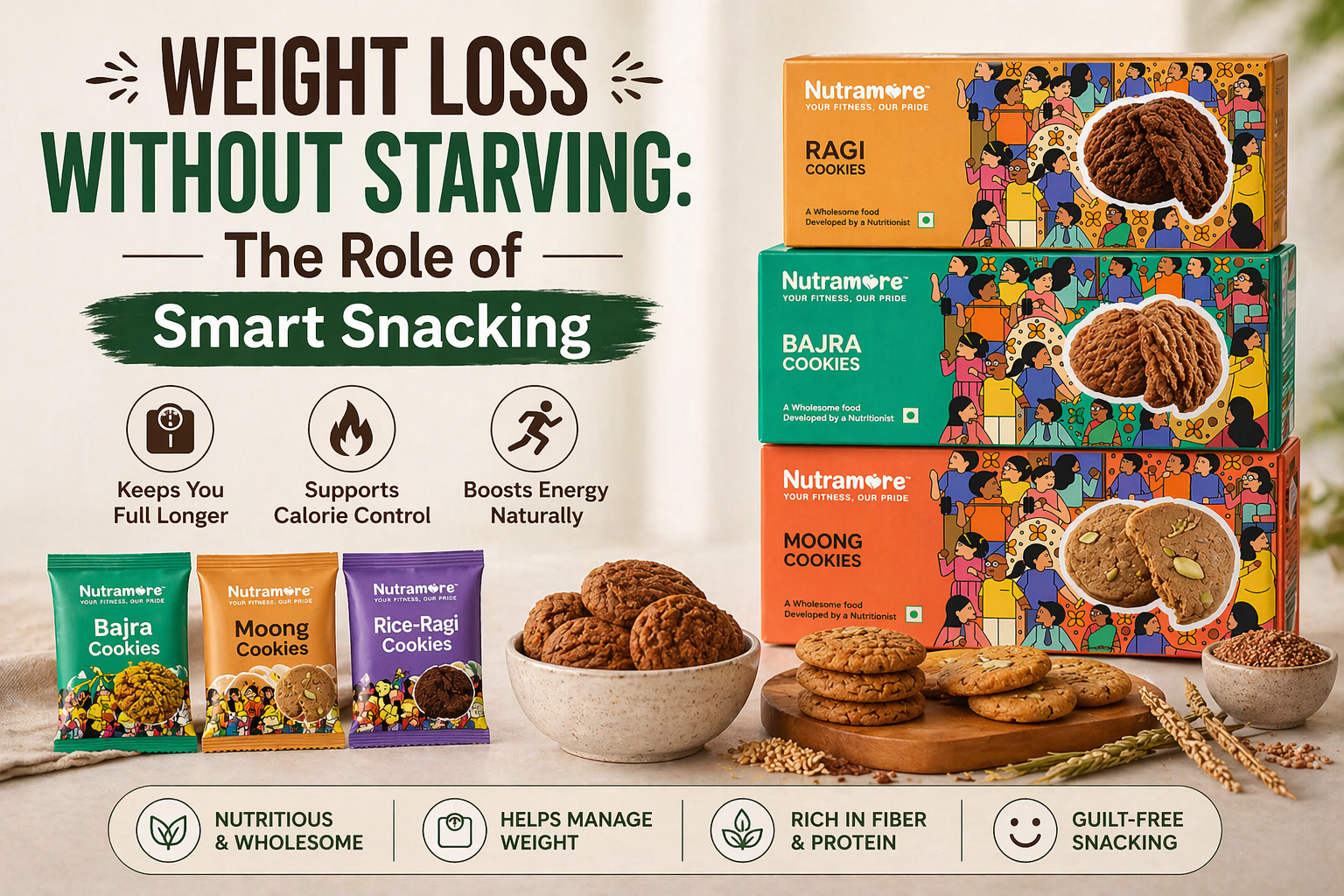
Ragi's calcium in full cofactor context. The 344mg of calcium per 100g in ragi is accompanied by the phosphorus, magnesium, and vitamin K cofactors that direct calcium to bone rather than to soft tissue — a nutritional precision that isolated calcium carbonate added to a cracker cannot provide. Nutramore's Ragi Chocolate Cookies and Rice Ragi Cookies deliver this calcium in the food matrix that optimises its utilisation for bone health.
Bajra's complete mineral profile. Beyond its commonly cited iron and magnesium content, bajra provides zinc, potassium, phosphorus, and selenium in proportions that reflect the soil-derived mineral profile of the grain — a diversity that no fortification programme adds in full. Bajra Cookies and Bajra Moong Chocolate Cookies deliver this complete mineral profile alongside the beta-glucan soluble fiber that no fortified biscuit attempts to replicate.
Pulse-derived complete protein with intrinsic cofactors. The 32g of protein in Green-Gram Upma Premix comes from whole green gram — with its intrinsic zinc, iron, B vitamins, and fiber that work together to support protein absorption and utilisation. Isolated whey or soy protein added to a fortified cereal comes without these cofactors, in a food matrix of refined carbohydrate that produces an entirely different metabolic context.
The fiber that no fortification adds. Perhaps the most significant absence in every fortified refined food is fiber. Fiber is not a micronutrient — it is not added during nutrient fortification. Yet fiber is the compound most directly responsible for gut microbiome health, GLP-1 and PYY satiety hormone production, resistant starch fermentation and SCFA generation, blood glucose moderation, and the long-term metabolic outcomes that distinguish whole food diets from refined food diets across every epidemiological measure. Whole millets contain 8–11g of fiber per 100g. Fortified refined flour contains less than 2g. This is not a gap that fortification even attempts to close.
What This Means in Practice: A Consumer Framework
Translating the science above into practical decision-making, here is a clear framework for evaluating fortified food claims:
Fortification is valuable when: The nutrient being added is genuinely difficult to obtain from whole food diets (B12 for vegetarians, vitamin D, iodine in deficient regions). The deficiency being addressed has significant health consequences and dietary change is not feasible in the short term. The fortification is used to supplement an otherwise whole-food-based diet rather than substitute for it.
Fortification is marketing when: The underlying food vehicle is refined, high-glycemic, sugar-containing, or low-fiber. The nutrients being added were present in the original whole grain before processing removed them. The fortification claim is used on the front of pack to create a health impression that the overall ingredient quality does not support. The same nutrients are available in superior form and superior bioavailability from whole food alternatives.
The practical test: For any fortified food, ask: does this food's ingredient list reflect quality and nutritional integrity independent of the added nutrients? If yes — if the base ingredients are whole, minimally processed, and nutritionally sound — fortification is an additive benefit. If no — if the base ingredients are refined, sugary, or fiber-free — the fortification is compensatory marketing on a nutritionally poor product, and a whole food alternative will always be superior.
Applied to Indian snacking: the answer to iron deficiency is not an iron-fortified maida biscuit. It is bajra — which contains more iron in a more bioavailable form, alongside fiber, magnesium, potassium, and polyphenols that no fortification adds. The answer to calcium deficiency is not calcium-fortified bread. It is ragi — which delivers extraordinary calcium in a food matrix that has been part of human nutrition for five thousand years. The answer to protein deficiency is not isolated protein added to a refined cereal. It is moong, green gram, and jowar — whole foods that deliver complete protein in its nutritional context.
Final Thoughts
Fortified food is not better than whole food. In virtually every nutritional dimension that determines long-term health outcomes — bioavailability, phytonutrient breadth, food matrix synergy, fiber content, and the integrated biological effects of a diet built on whole, minimally processed foods — whole foods are superior to fortified refined alternatives, regardless of which specific nutrients have been added and in what quantities.
Fortification has genuine and important public health value in specific, targeted applications — addressing specific deficiencies in specific nutrients that genuinely cannot be obtained from whole food diets. In that role, it saves lives and prevents disease. This is not the application being questioned.
What is being questioned is the commercial use of fortification claims to sell nutritionally poor processed foods as health products — and the implicit consumer belief that a fortified biscuit, cereal, or snack is nutritionally comparable to the whole food it partially mimics. It is not. It cannot be. Because the whole food delivers a nutritional complexity that no regulatory list of permitted additives, no matter how comprehensive, can fully replicate.
The practical answer for Indian families is straightforward: build the snack drawer around whole millets and pulses — bajra, jowar, ragi, moong, green gram — in minimally processed forms that retain the bran, the germ, the polyphenols, the fiber, and the complete mineral profile that industrial processing removes and fortification only partially restores. Choose fortification as a supplement to this foundation when specific deficiencies warrant it. Do not choose it as a substitute.
The tradition of Indian nutrition — built on whole grains and pulses in their complete, unprocessed form — was right before the science existed to explain why. The science now exists. The conclusion is the same.
Explore Nutramore's full range of whole-ingredient millet snacks at nutramore.in/our-products