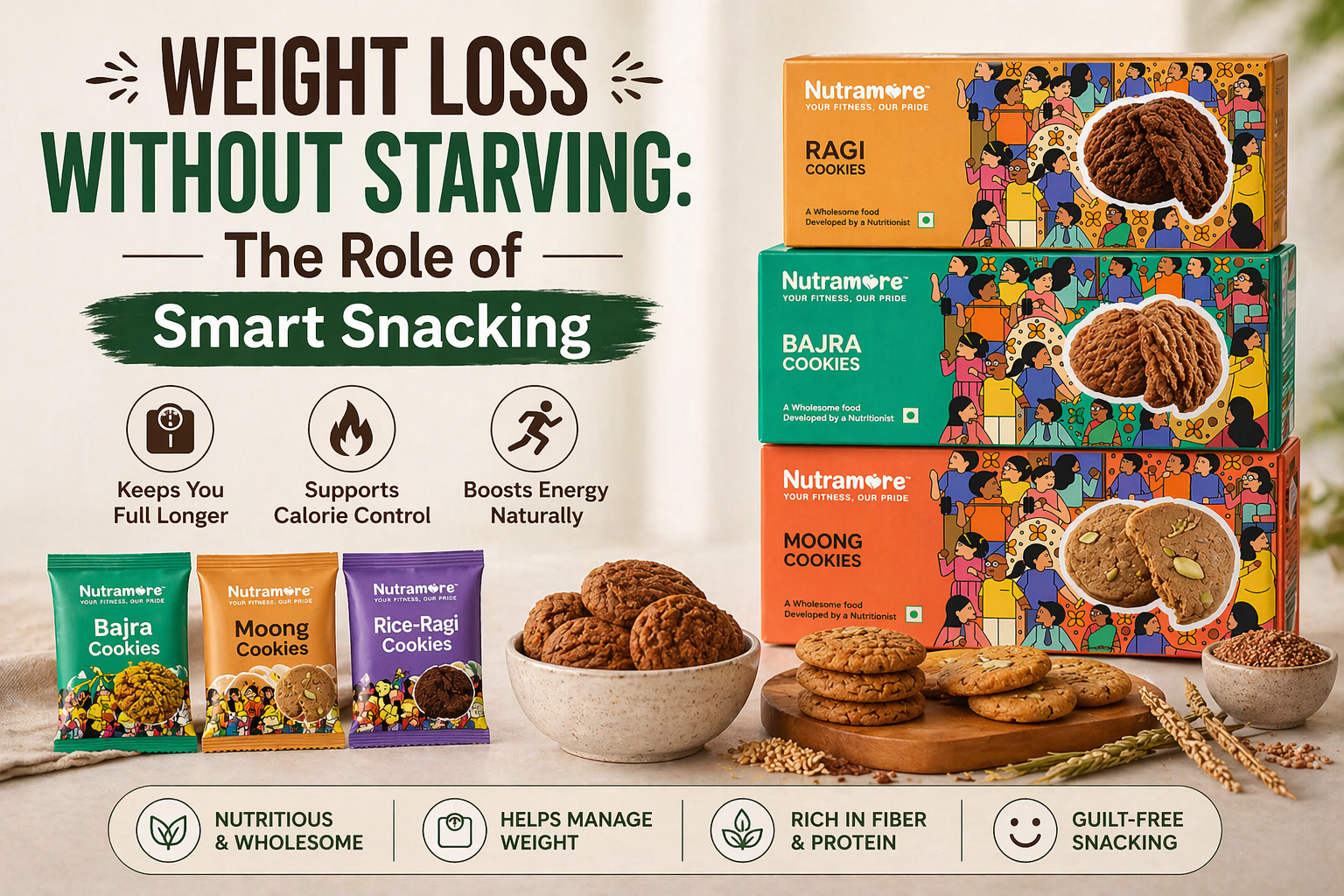
The dominant narrative around weight loss in India — and globally — goes something like this: eat less, move more, endure hunger, repeat. The hunger is not a side effect to be managed. It is the point. It is proof that the deficit is working. It is the discomfort you are supposed to push through on your way to results.
This narrative is not just unpleasant. It is physiologically incorrect.
Hunger — chronic, significant, frequent hunger — is not a signal that fat loss is happening. It is a signal that the body's survival systems are activating: cortisol is rising, ghrelin is surging, thyroid output is falling, and the metabolic adaptations that make weight loss progressively harder are accumulating with every hungry hour. As explored in the previous blog on meal skipping, starvation-pattern eating does not produce sustainable fat loss. It produces short-term weight loss followed by metabolic suppression, muscle catabolism, and the rebound weight gain that makes each subsequent attempt harder than the last.
The evidence-based alternative is not about eating more — it is about eating smarter. Specifically, it is about understanding how the right snacks at the right times can maintain the hormonal and metabolic environment in which fat loss occurs naturally, without the hunger that triggers the body's defensive response.
This blog makes the complete scientific and practical case for smart snacking as a weight loss strategy — not as an indulgence dressed up in nutritional language, but as a genuine, mechanistically sound approach to achieving and maintaining a healthy body composition without fighting your own biology.
Redefining What Weight Loss Actually Requires
Before getting into snacking strategy, it is worth establishing what sustainable fat loss actually requires at a physiological level — because the common understanding is significantly incomplete.
Fat loss requires one condition: the body must mobilise stored fat and oxidise it for energy. For this to happen consistently, three things must be true simultaneously.
First, there must be a modest caloric deficit — the body must expend slightly more energy than it takes in, so that stored energy (fat) is recruited to make up the difference. The word modest matters here. A deficit of 300–500 calories per day is sufficient to produce steady fat loss while keeping the metabolic and hormonal systems operating normally. Deficits above 700–800 calories activate adaptive thermogenesis and muscle catabolism — which reduce the effective deficit over time and damage the muscle mass that drives resting metabolic rate.
Second, insulin must be low enough to permit fat mobilisation. As discussed in the blood sugar blog, insulin directly suppresses lipolysis — the breakdown of stored fat. When insulin is chronically elevated due to frequent blood sugar spikes from high-glycemic foods, fat stores remain locked regardless of caloric restriction. Keeping insulin in a range that permits fat mobilisation requires eating foods that produce modest, controlled glucose responses — which is the precise nutritional profile of low-GI, high-fiber, protein-rich snacks.
Third, cortisol must be kept within a normal functional range. Elevated cortisol — from stress, from blood sugar crashes, from meal skipping, or from excessive caloric restriction — promotes visceral fat accumulation, degrades lean muscle mass, and impairs the thyroid function that sets resting metabolic rate. Paradoxically, the hunger created by restrictive dieting is itself a cortisol-elevating stressor — which is why aggressive caloric restriction often produces the specific fat distribution pattern (abdominal, visceral fat) that it is supposed to be reducing.
Smart snacking directly supports all three of these conditions: it creates a modest caloric contribution that prevents the extreme deficit that triggers cortisol and adaptive thermogenesis, it maintains insulin in a range that permits fat mobilisation through its low-GI food profile, and it keeps cortisol stable by preventing the blood sugar crashes and hunger emergencies that activate the stress response.
The Satiety Science: How Snacks Control Hunger Without Adding to Weight
The mechanism through which smart snacking supports weight loss without adding to it lies in satiety — the physiological state of feeling satisfied after eating, maintained by the interplay of several hormones that signal the brain to stop eating and remain comfortable between meals.
The two most important satiety signals for snacking purposes are GLP-1 (glucagon-like peptide-1) and PYY (peptide YY) — both produced in the gut and both signalling the hypothalamus to reduce appetite. GLP-1 is particularly important because it also enhances insulin sensitivity, meaning that the satiety effect comes packaged with metabolic benefit. Both GLP-1 and PYY are powerfully stimulated by protein and fiber — the two nutritional components that define a well-constructed snack.
On the hunger side, ghrelin — produced in the stomach and driving appetite — is suppressed by protein consumption more effectively than by any other macronutrient. A snack containing 10–15g of protein can suppress ghrelin for 2–3 hours — meaningfully reducing appetite at the subsequent meal and the total caloric intake across the day.
The practical consequence of this hormonal interaction is the "second meal effect" — a well-documented phenomenon in nutritional research showing that a low-GI, high-protein, high-fiber snack consumed mid-morning significantly reduces the glycemic response and total caloric intake at the subsequent lunch, not just by reducing hunger but by improving insulin sensitivity and slowing gastric emptying in a way that persists into the next meal.
This is the mechanism through which smart snacking produces weight loss that cannot be achieved through restriction alone: by keeping the hormonal environment favourable for fat loss throughout the day — low ghrelin, high GLP-1 and PYY, stable insulin, controlled cortisol — you eat less at main meals naturally, mobilise fat more consistently, and avoid the compensatory overeating that restriction-based approaches reliably generate.
The Caloric Math of Smart Snacking
One of the most common objections to snacking for weight loss is simple arithmetic: if snacking adds calories, how does it produce a deficit?
The answer lies in understanding that total daily caloric intake is not determined solely by what is deliberately eaten — it is determined by the interplay between what is eaten and how hunger hormones respond to it across the full day.
Consider two scenarios for a person consuming the same number of main meals:
Scenario A — No snacks: The person eats breakfast, skips mid-morning, eats lunch, skips afternoon, eats dinner. By the time each main meal arrives, ghrelin is significantly elevated from the preceding hunger gap. The person consistently overeats at each meal — an additional 150–250 calories per meal is common in research measuring meal size after extended hunger periods. Total caloric overconsumption from three meals eaten in a state of elevated ghrelin: 450–750 extra calories beyond what would have been consumed with stable hunger.
Scenario B — Smart snacks: The person eats breakfast, has a 150-calorie millet cookie snack mid-morning, eats lunch (which is naturally smaller because ghrelin is controlled), has a 120-calorie protein stick snack mid-afternoon, eats dinner (which is smaller again). Snack calories added: 270. Meal calories reduced through ghrelin suppression and the second meal effect: 300–400 total across the day. Net result: a lower total caloric intake despite eating more frequently, alongside a more favourable insulin and cortisol profile that further supports fat mobilisation.
This is not a theoretical model — it is the consistent finding of controlled research comparing snacking versus non-snacking eating patterns matched for intended caloric intake. People who snack strategically consume fewer total daily calories than those who do not, despite adding snack calories, because the satiety effect of well-chosen snacks reduces meal portion sizes by a greater margin than the snack itself contributes.
The key word, again, is "strategically." This effect is produced by protein-and-fiber-rich, low-GI snacks. It is not produced by refined flour biscuits that spike and crash blood sugar, intensify ghrelin after the spike crashes, and add to the hormonal conditions that promote overeating.
The Protein Priority: Why It Is the Single Most Important Snacking Variable
Across all of the nutritional variables involved in weight loss — glycemic index, fiber content, caloric density, fat type, sweetener quality — protein has the most consistent and most powerful relationship with successful fat loss outcomes.
The mechanisms are multiple and additive:
Protein has the highest thermic effect. Approximately 20–30% of protein calories are burned in the process of digestion and metabolism — meaning a 100-calorie protein-containing snack effectively provides only 70–80 net calories to the body. This is two to three times the thermic "discount" of carbohydrate and ten times that of fat.
Protein suppresses ghrelin most powerfully. In head-to-head comparisons of equivalent caloric snacks varying in macronutrient composition, protein-dominant snacks consistently produce the greatest and most sustained ghrelin suppression — reducing appetite at the subsequent meal more effectively than fat-dominant or carbohydrate-dominant snacks of the same caloric value.
Protein stimulates GLP-1 and PYY. Both of these satiety hormones are powerfully stimulated by protein — and both have caloric intake reducing effects that extend beyond the satiety of the snack itself into the subsequent meal.
Protein preserves lean muscle during a caloric deficit. Without adequate protein, caloric restriction produces weight loss that is partially fat but significantly muscle — reducing metabolic rate and producing the weight loss that comes with a metabolically slower body. With adequate protein, the same caloric deficit produces primarily fat loss while preserving muscle — maintaining metabolic rate and producing a body composition change rather than simply a scale change.
The research consistently indicates that distributing 25–30g of protein across five to six daily eating occasions — including snacks — produces better fat loss outcomes and better muscle preservation than the same total protein consumed in two or three large meals.
Nutramore's Baked Protein Sticks at 18g of protein per 75g pack represent one of the most protein-dense ready-to-eat snack formats in the Indian market — from whole dal, not isolated protein, which means the protein comes with fiber, micronutrients, and the low-GI carbohydrate matrix that further supports blood sugar stability. Green-Gram Upma Premix at 32g per serving and Jowar Chilla Mix at 30g per serving are, for anyone building a weight loss eating plan, among the most metabolically effective breakfast or heavy snack options available.
Millets and Fat Loss: The Specific Mechanisms
Beyond their general low-GI advantage, specific millets have documented mechanisms that directly support fat loss — and understanding these gives the choice of millet-based snacks a scientific foundation that goes beyond simple carbohydrate comparison.
Jowar's resistant starch and SCFA production. The resistant starch in jowar is fermented by colonic bacteria into short-chain fatty acids — particularly butyrate — that have multiple documented fat-loss-supporting effects. Butyrate directly activates the PPAR-gamma receptor in fat cells in a way that promotes fat oxidation rather than fat storage. It also supports the production of GLP-1 from gut enteroendocrine cells — amplifying the satiety signal that reduces caloric intake at subsequent meals. Jowar Coconut Cookies and Jowar Chocolate Cookies deliver these benefits in a genuinely enjoyable snack format.
Bajra's magnesium and insulin sensitivity. As discussed in previous blogs, bajra's exceptional magnesium content directly supports insulin receptor sensitivity — the fundamental cellular mechanism that determines whether glucose is metabolised for energy or stored as fat. Improved insulin sensitivity means more glucose is used for energy and less triggers fat storage at any given blood glucose level. This is the nutrient-level mechanism through which regular bajra consumption supports fat loss independent of its caloric content. Bajra Cookies and Bajra Moong Chocolate Cookies make this magnesium contribution consistent and practical.
Ragi's polyphenols and adipogenesis inhibition. Ragi contains a specific combination of polyphenols — including catechins and epicatechins — that have been shown in cell culture and animal studies to inhibit the differentiation of pre-adipocytes into mature fat cells (adipogenesis). While human studies on this specific mechanism are still emerging, the polyphenol content of ragi also directly inhibits the digestive enzymes that break down carbohydrates — reducing effective carbohydrate absorption and the glycemic response of any meal in which ragi is present. Ragi Chocolate Cookies and Rice Ragi Cookies provide these polyphenols in a daily snack context.
Fenugreek's galactomannan and appetite suppression. The fenugreek in Millet Methi Crispies contains galactomannan — a soluble fiber that swells significantly in the stomach, creating a feeling of physical fullness that extends well beyond the caloric content of the snack. Clinical trials have demonstrated that galactomannan consumption before meals reduces caloric intake at the subsequent meal by 10–15% — a meaningful effect from a single snack ingredient.
Timing Smart Snacks for Maximum Fat Loss Effect
The timing of snacks — not just their content — determines how effectively they support the hormonal conditions for fat loss. The key is placing snacks at the moments when hunger hormones are beginning to rise and blood sugar is beginning to fall, rather than waiting for the hunger crisis to fully materialise.
The mid-morning window (10–10:30am) is the first critical timing point. After a breakfast eaten at 7–8am, blood glucose begins to fall by 10am in most people. Catching this fall before it produces significant ghrelin elevation — with a snack at 10–10:30 — prevents the cortisol response and ghrelin spike that would otherwise intensify lunch appetite. A small snack of two to three millet cookies or a handful of nuts alongside a protein source is sufficient to bridge this gap.
The mid-afternoon window (3:30–4pm) is the second. Post-lunch glucose begins to fall around 3pm, and the cortisol dip of the mid-afternoon compounds this. Without a snack, by 5pm most people are experiencing significant hunger, fatigue, and cravings for high-energy foods — the conditions that produce the evening overeating that undermines otherwise well-managed days. A protein-and-fiber snack at 3:30–4pm interrupts this cascade before it develops. Millet Methi Crispies or Moong Almond Pistachio Cookies are particularly well-suited to this window — satisfying, low-GI, protein-containing, and calorie-modest enough not to meaningfully impact the daily caloric budget.
Pre-workout (45–60 minutes before exercise) is a specific timing window relevant for those using exercise as part of their fat loss strategy. A snack at this point should provide slow-release carbohydrate for fuel without spiking blood sugar — jowar or bajra-based options are ideal. It should be modest — 150–200 calories — to avoid digestive discomfort during exercise without leaving the person under-fuelled.
Post-workout (within 30–45 minutes) is the window during which muscle protein synthesis is most responsive to protein input — the so-called "anabolic window." A protein-rich snack at this point not only supports muscle repair and maintenance but also specifically reduces the cortisol-driven muscle catabolism that follows intense exercise. Baked Protein Sticks or Jowar Chilla in a post-workout context provide both the protein substrate for muscle synthesis and the low-GI carbohydrate that helps restore muscle glycogen without an excessive insulin response.
The Mindful Snacking Dimension
Physical biology drives much of snacking behaviour — but psychology is equally important, and addressing it honestly is part of a complete smart snacking strategy.
Much of what is identified as hunger between meals is not physiological hunger — it is habitual eating triggered by environmental cues (the time of day, the sight of food, the smell of the office kitchen), emotional states (boredom, stress, anxiety, loneliness), or the reward-seeking behaviour that refined sugar products specifically exploit.
The distinction between genuine hunger and cue-driven or emotional eating has practical significance for weight management: genuine hunger is a signal that the body needs fuel and should be responded to — with a smart snack. Cue-driven or emotional eating is a signal that the brain is seeking something other than food — and responding to it with food, however nutritious, does not address the underlying need and can add unnecessary caloric intake.
A simple test: genuine physiological hunger develops gradually over time, is satisfied by any food, and is accompanied by physical sensations (stomach emptiness, mild energy drop). Cue-driven hunger appears suddenly in response to a trigger, is specifically focused on a particular type of food (usually high-sugar or high-fat), and does not diminish when genuine food is offered.
Keeping genuinely nutritious, low-caloric, satisfying snacks available — such that when cue-driven eating happens, the default option is a millet cookie rather than a packet of chips — is the environmental design approach that works best alongside mindful awareness. The Try & Taste Trial Pack with nine different mini flavour packs is useful here specifically because the variety addresses the novelty-seeking aspect of cue-driven eating — there is always something different and interesting to try, reducing the appeal of seeking novelty in less nutritious options.
Building a Week of Smart Snacking for Weight Loss
To make all of this practical and immediately actionable, here is a full week of smart snacking designed specifically for weight loss — each snack timed appropriately, protein-containing, low-GI, and genuinely enjoyable:
Monday: Mid-morning (10am) — Baked Protein Sticks half pack + a small guava. Afternoon (4pm) — Bajra Cookies 2–3 pieces + roasted chana.
Tuesday: Mid-morning — Jowar Chilla half serving with curd. Afternoon — Millet Methi Crispies small serving + buttermilk.
Wednesday: Mid-morning — Moong Almond Pistachio Cookies 2–3 pieces + a handful of walnuts. Afternoon — Jowar Chocolate Cookies 2 pieces + a small apple.
Thursday: Mid-morning — Green-Gram Upma half serving with lime. Afternoon — Bajra Moong Chocolate Cookies 2–3 pieces + plain curd.
Friday: Mid-morning — Baked Protein Sticks half pack + cucumber. Afternoon — Ragi Chocolate Cookies 2 pieces + a small handful of almonds.
Saturday: Mid-morning — Jowar Upma half serving. Afternoon — Rice Ragi Cookies 2–3 pieces + warm spiced buttermilk.
Sunday: Mid-morning — Multigrain Coffee Cookies 2–3 pieces + a small handful of pistachios. Afternoon — Millet Methi Crispies + a piece of seasonal fruit.
Each day's snacking contributes approximately 270–380 calories from two occasions — in exchange for meaningfully reduced main meal appetite, controlled ghrelin throughout the day, stable insulin that permits fat mobilisation, and the preservation of lean muscle mass that keeps the metabolic rate from declining.
For families wanting to build this snacking infrastructure across the full week without daily shopping decisions, the Savoury Snacks Combo covers both savoury snack occasions, the Gluten-Free Cookies Combo covers sweet snack variety, and the Breakfast Premix Combo handles the heavier protein snack occasions — together creating a complete, rotation-ready snack pantry that requires no daily decision-making.
What Smart Snacking Is Not
As important as what smart snacking is, it is worth being equally clear about what it is not — because the concept can be misappropriated in ways that undermine its effectiveness.
Smart snacking is not unlimited snacking. The hormonal benefits described depend on modest-sized snacks of 150–250 calories. Treating millet cookies as unlimited because they are "healthy" eliminates the caloric component of the weight loss equation and adds unnecessary glucose load.
Smart snacking is not a substitute for main meals. Snacks serve the bridging function — they fill the gap between meals and prevent the hormonal conditions that undermine those meals. Replacing meals with snacks eliminates the protein distribution that supports muscle mass and the micronutrient variety that supports overall health.
Smart snacking is not independent of main meal quality. If main meals are high-GI, refined, or protein-poor, no snacking strategy can fully compensate. Smart snacking works best as part of a coherent dietary approach that includes nutritious main meals.
Smart snacking is not the same for everyone. Individual metabolic responses to food vary meaningfully — one person's blood sugar response to the same food may differ significantly from another's based on gut microbiome composition, insulin sensitivity baseline, activity level, and genetic factors. The framework in this blog is based on population-level evidence and is appropriate as a starting point, but individual response monitoring — how hunger, energy, and weight respond over two to four weeks — is the refinement layer that optimises the approach for the individual.
The Long Game: Why Sustainability Is the Real Weight Loss Variable
Every dietary approach that produces weight loss in the short term fails if it cannot be maintained. Starvation, extreme restriction, and hunger-based diets produce rapid early results that are metabolically unsustainable and psychologically exhausting. The majority of people who lose weight through restriction regain it within one to two years — not because of weakness, but because the metabolic adaptations and psychological pressure generated by the restrictive approach make maintenance impossible.
Smart snacking, by contrast, is sustainable precisely because it does not require willpower expenditure. There is no hunger to push through. There is no food to deny yourself. There is no metabolic suppression to overcome. The approach works with the body's hormonal systems rather than against them — and a strategy that works with biology can be maintained indefinitely, producing the slow, consistent fat loss trajectory that accumulates into lasting results.
The standard is not dramatic transformation in eight weeks. It is gradual, steady progress that continues because the person is never miserable enough to abandon the approach, never hungry enough to binge, and never metabolically suppressed enough to plateau into frustration.
That standard — sustainable, comfortable, metabolically sound — is what smart snacking is designed to support. And it is the standard that actually produces the long-term body composition outcomes that restrictive dieting consistently fails to deliver.
Final Thoughts
Weight loss does not require starvation. It requires a hormonal environment in which the body mobilises stored fat comfortably — which means stable blood sugar, controlled insulin, managed cortisol, suppressed ghrelin, and preserved lean muscle mass. Smart snacking — timed appropriately, protein-and-fiber-rich, low-GI, jaggery-sweetened rather than refined-sugar-sweetened — creates and maintains precisely that environment, multiple times per day.
The snack drawer is not the enemy of weight loss. The wrong snack drawer is. The right one — stocked with millet-and-pulse-based options that deliver protein, fiber, low glycemic load, and genuine satisfaction — is one of the most practical tools available for sustainable fat loss without hunger, without metabolic suppression, and without the exhausting willpower-versus-biology battle that restrictive approaches demand.
Eat smarter. Eat more often. Lose weight more sustainably than you ever did by eating less.
Explore Nutramore's full range of smart, weight-loss-supporting millet snacks at nutramore.in/our-products